WHY butter?Butter is rich in short and medium chain fatty acids, including even small amounts of lauric acid. It is rich in antioxidants as well, in the form of beta carotene, vitamin E, and selenium. It is one of the best sources of vitamin A. Because living grass is richer in vitamins E, A, and beta-carotene than stored hay or standard dairy diets, butter from dairy cows grazing on fresh pasture is also richer in these important nutrients. The naturally golden color of grass-fed butter is a clear indication of its superior nutritional value.
By nature, cows are grazing (grass-eating) animals. 85-95% of dairy cows today are raised in confinement on a diet of grain, particularly corn, because it is far more cost-efficient for agribusiness. This grain-based diet can cause changes in the ph in cows, creating many abnormal physiological conditions in the cow, which can increase the need for the use antibiotics.
The CLA Advantage
Conjugated Linoleic Acid (CLA) is a naturally occurring free fatty acid found mainly in meat and dairy products in small amounts. CLA was discovered by accident in 1978 by Michael W. Pariza at the University of Wisconsin while looking for mutagen formations in meat during cooking. The most abundant source of natural CLA is the meat and dairy products of grass-fed animals. Research conducted since 1999 shows that grazing animals have from 3-5 times more CLA than animals fattened on grain in a feedlot. Simply switching from grain-fed to grass-fed products can greatly increase your intake of CLA.
I often make my own butter
and cultured butter from local cream, but it has been pasteurized before
I can get it, Thanks to government regulations that make the dairies
cook out all the good enzymes. It's not bad butter, but not great
either, except compared to commercial butter.
A friend sent me a link
to a site that sells imported close-out cheese, charcuterie and things
like butter, at good prices. This time they have pastured butter from New
Zealand for $4 a pound (Anchor brand). It's hard to really know if this
pastured butter is made with raw milk rather than pasteurized milk.
They say it's made from "fresh milk collected twice daily" but never actually say if it's pasteurized or not.
Either way, I'm ordering at least 5 pounds because butter freezes well. Got to be better than what I can buy here, and for more $$.
About this butter:
New Zealand Anchor Butter from grass-fed, free-range cows has a richer taste
versus barn raised non grass fed animals. Butter from grass fed cows is
higher in Omega 3, Beta Carotene and Vitamin A.
Free Range
Means cows are feed on grass only, 365
days of the year. Therefore no grain, artificial feed or meat & bone
meal is feed to cows on New Zealand’s farms.
Means naturally raised and humane living conditions for cows 24/7.
No Hormones
The New Zealand government prohibits the use
of animal growth hormones in dairy, sheep and beef farming. There is
mounting evidence that growth hormones can adversely affect the heath of
cattle and humans.
Made for 100% from fresh milk
Our milk is collected twice a day from the farm.
Not made by reconstituting milk power and anhydrous milk fat.
Showing posts with label Oils and Fats. Show all posts
Showing posts with label Oils and Fats. Show all posts
Thursday, April 25, 2013

Tuesday, April 9, 2013
Deer in the Headlights
We all know that vitamins we get from natural food sources are more easily assimilated in our bodies than synthetic vitamins. So are essential fatty acids.
I posted a blip about the importance of a proper ratio of Omega 6 fatty acids to Omega 3 fatty acids a few days ago. Those fats are considered essential because our bodies cannot make them, and they really ARE essential to us.
Here's a copy from a post by Ted Slanker with specifics about humans and cattle eating green leafy plants and/or grains.... and what each choice does to the O-6:O-3 ratio. He explains it so much better than I could...
"Scientists have determined that the “essential fats” in the membranes of cells have a very powerful influence on each cell’s ability to function. These essential fats consist of the Omega-6 family of fatty acids and the Omega-3 family of fatty acids. Via laboratory experiments on rats and in some cases humans, scientists have determined that the appropriate balance between these fats is one to one. That means the O-6 and O-3 fatty acids must be in nearly perfect balance for proper cell function. When the balance between O-6 to O-3 exceeds 4:1 cells malfunction and chronic disease is the result. All chronic diseases are body failings. They include, but are not limited to, heart disease, cancer, diabetes, arthritis, lupus, attention deficit syndrome, autism, and most other mental disorders, Crohn’s disease, obesity, osteoporosis, and the list goes on and on.
A chemical analysis of the fatty acid profiles of the cells of cattle tells the story that is common for all animal life. Cattle, which are raised on pastures and only in major emergencies are fed hay, have a 1:1 fatty acid ratio. Feedlot steers that have been fed grain have a ratio of 15:1 or higher. Skinless chicken breasts from chickens fed all “vegetarian diets” (grain) have a 18:1 ratio.
Here are some additional ratios:
wheat 11:1
rice bran 32:1
corn germ 59:1
raw kale 0.5:1
raw spinach 0.1:1
Many of the vitamins required by animals and humans come directly from the leafy, green plants or the meats from animals that ate the leafy, green plants. Without this tie animals can experience severe vitamin deficiencies. For instance, after 180 days in a feedlot eating grain a steer can lose as much as 80% of the vitamin A that would normally be in its liver and 75% of the vitamin E that would be in its muscle tissues!
But what about grain? Why is it bad? Grain is the seed head of grasses. Grain is one of the ways the grass-plant kingdom perpetuates itself. Consequently, the plant kingdom does everything it can to protect its survival as a species. Grains can host defensive fungi (endophyte) and mycotoxins. Mycotoxins are nearly all cytotoxic, disrupting various cellular structures such as membranes and interfering with vital cellular processes such as protein, RNA, and DNA synthesis.
Of course, they are also toxic to the cells of higher plants and animals, including humans. In addition, the chemical composition of seed heads differs significantly from the leafy, green plants themselves. Green plants can be clipped over and over again and they grow back. A green leaf falls to the ground and it becomes a food source for microorganisms that break down the leaf into organic matter that ultimately feeds the next generation of green plants. The green plant creates its own perfect cycle.
A seed head has a strong protective coat that protects the “internal workings.” When a seed falls to the ground it can remain in the soil for decades (under appropriate conditions) and still sprout when favorable conditions occur. For grain to perform its natural function it has to have a totally different fatty acid profile than the grass it will be once it sprouts. Seeds cannot re-grow. They are the grass plant’s one-time shot.
Man invented grain farming by isolating certain grasses and protecting them from grazing pressure until their seeds had ripened. Then he harvested the seeds in a narrow window of time and was able to store the seeds for future use. This turned a minor food source into something that was more abundant.
Unfortunately, even though grain farming increased the quantity of “food” available for the masses, it dramatically lowered the health of the people who ate the new food source.
Today, in America’s grain-based food system in which nearly all livestock products come from grain-fed livestock and nearly all food products have grain additives or are made from grain because it is cheap, the food system is more grain-based than during any other civilization in the history of the world except that of India. This is why 70% of all deaths in our nation are due to chronic diseases. Most other deaths are from accidents, infectious diseases, murders, and wars. Very few people die of natural causes in our country.
Here's why. Take a steer off pasture and put him in a feedlot. As he comes off pasture his O6 to O3 fatty acid ratio is close to 1:1. After about 180 days in the feedlot his fatty acid ratio will have increased to the 15:1 to 18:1 range. As his fatty acid ratio changes his vitamin levels plunge. Vitamin A in the steer's liver can drop as much as 80%. Vitamin E in his muscle tissue can fall 75%.
This is the same thing that happens to people who eat grains, grain-based foods, and food products from grain-fed livestock. Alarmingly, scientists in the know estimate that due to "modern" foods the average American consumes a fatty acid ratio of from 20:1 to 30:1.
It's no wonder then that children in America (grain-fed from conception) have ADD, diabetes, are obese, and suffer from many other chronic diseases unheard of 60 years ago. Their parents are in deeper trouble, yet they are none the wiser.
The entire population resembles deer in the headlights. It focuses on materialistic consumption while its health and well-being wallows in the sewer."
I posted a blip about the importance of a proper ratio of Omega 6 fatty acids to Omega 3 fatty acids a few days ago. Those fats are considered essential because our bodies cannot make them, and they really ARE essential to us.
Here's a copy from a post by Ted Slanker with specifics about humans and cattle eating green leafy plants and/or grains.... and what each choice does to the O-6:O-3 ratio. He explains it so much better than I could...
"Scientists have determined that the “essential fats” in the membranes of cells have a very powerful influence on each cell’s ability to function. These essential fats consist of the Omega-6 family of fatty acids and the Omega-3 family of fatty acids. Via laboratory experiments on rats and in some cases humans, scientists have determined that the appropriate balance between these fats is one to one. That means the O-6 and O-3 fatty acids must be in nearly perfect balance for proper cell function. When the balance between O-6 to O-3 exceeds 4:1 cells malfunction and chronic disease is the result. All chronic diseases are body failings. They include, but are not limited to, heart disease, cancer, diabetes, arthritis, lupus, attention deficit syndrome, autism, and most other mental disorders, Crohn’s disease, obesity, osteoporosis, and the list goes on and on.
A chemical analysis of the fatty acid profiles of the cells of cattle tells the story that is common for all animal life. Cattle, which are raised on pastures and only in major emergencies are fed hay, have a 1:1 fatty acid ratio. Feedlot steers that have been fed grain have a ratio of 15:1 or higher. Skinless chicken breasts from chickens fed all “vegetarian diets” (grain) have a 18:1 ratio.
Here are some additional ratios:
wheat 11:1
rice bran 32:1
corn germ 59:1
raw kale 0.5:1
raw spinach 0.1:1
Many of the vitamins required by animals and humans come directly from the leafy, green plants or the meats from animals that ate the leafy, green plants. Without this tie animals can experience severe vitamin deficiencies. For instance, after 180 days in a feedlot eating grain a steer can lose as much as 80% of the vitamin A that would normally be in its liver and 75% of the vitamin E that would be in its muscle tissues!
But what about grain? Why is it bad? Grain is the seed head of grasses. Grain is one of the ways the grass-plant kingdom perpetuates itself. Consequently, the plant kingdom does everything it can to protect its survival as a species. Grains can host defensive fungi (endophyte) and mycotoxins. Mycotoxins are nearly all cytotoxic, disrupting various cellular structures such as membranes and interfering with vital cellular processes such as protein, RNA, and DNA synthesis.
Of course, they are also toxic to the cells of higher plants and animals, including humans. In addition, the chemical composition of seed heads differs significantly from the leafy, green plants themselves. Green plants can be clipped over and over again and they grow back. A green leaf falls to the ground and it becomes a food source for microorganisms that break down the leaf into organic matter that ultimately feeds the next generation of green plants. The green plant creates its own perfect cycle.
A seed head has a strong protective coat that protects the “internal workings.” When a seed falls to the ground it can remain in the soil for decades (under appropriate conditions) and still sprout when favorable conditions occur. For grain to perform its natural function it has to have a totally different fatty acid profile than the grass it will be once it sprouts. Seeds cannot re-grow. They are the grass plant’s one-time shot.
Man invented grain farming by isolating certain grasses and protecting them from grazing pressure until their seeds had ripened. Then he harvested the seeds in a narrow window of time and was able to store the seeds for future use. This turned a minor food source into something that was more abundant.
Unfortunately, even though grain farming increased the quantity of “food” available for the masses, it dramatically lowered the health of the people who ate the new food source.
Today, in America’s grain-based food system in which nearly all livestock products come from grain-fed livestock and nearly all food products have grain additives or are made from grain because it is cheap, the food system is more grain-based than during any other civilization in the history of the world except that of India. This is why 70% of all deaths in our nation are due to chronic diseases. Most other deaths are from accidents, infectious diseases, murders, and wars. Very few people die of natural causes in our country.
Here's why. Take a steer off pasture and put him in a feedlot. As he comes off pasture his O6 to O3 fatty acid ratio is close to 1:1. After about 180 days in the feedlot his fatty acid ratio will have increased to the 15:1 to 18:1 range. As his fatty acid ratio changes his vitamin levels plunge. Vitamin A in the steer's liver can drop as much as 80%. Vitamin E in his muscle tissue can fall 75%.
This is the same thing that happens to people who eat grains, grain-based foods, and food products from grain-fed livestock. Alarmingly, scientists in the know estimate that due to "modern" foods the average American consumes a fatty acid ratio of from 20:1 to 30:1.
It's no wonder then that children in America (grain-fed from conception) have ADD, diabetes, are obese, and suffer from many other chronic diseases unheard of 60 years ago. Their parents are in deeper trouble, yet they are none the wiser.
The entire population resembles deer in the headlights. It focuses on materialistic consumption while its health and well-being wallows in the sewer."
Wednesday, December 28, 2011
Health Care vs Illness Care
We should start naming things as they really are, not what someone would like us to believe. What we really have is Illness Care, NOT Health Care. Very little money is ever spent to promote "Health Care" because Health is NOT profitable.
The human body is extremely complex, and we have hundreds of thousands of internal interactions going on at any given moment from our 400 hundred trillion cells. Those interactions are also interdependent, and although our bodies have the ability to fabricate some of the components, we still need some raw materials for manufacturing them.

For a different picture for understanding, think about the group children's game we call jump rope; when typically done by 3 or more children it's called long rope jumping. If you have 3 children and a rope, you can play. Remove any one component, and there's no game. 2 children and a rope but no jumper... no game. 3 children and no rope, no game.
Micronutrients (meaning we don't need much of them) like the fat-soluble vitamins have a 'game' (interaction) going on in our bodies too, and if any one of them is MIA, the 'game' suffers. Please note that these essential fat-soluble vitamins can only be dissolved in saturated fats in the body (hence their name). A healthy liver will store any excess, unlike the water-soluble vitamins which we rapidly excrete in urine.


Vitamin A (egg yolks, liver, whole milk, cheese) is needed for eyesight, in other words "essential
for the neural transmission of light into vision". All the fat-soluble vitamins (A, D, E, K) need a bit of all the others to function (play the game) properly.
I find it interesting that the amount of Vitamin A in egg yolks in the Netherlands is more than twice the amount in the US. I wonder why? What they are fed (non-GMO?) and how they are raised? Curious. source
I find it interesting that the amount of Vitamin A in egg yolks in the Netherlands is more than twice the amount in the US. I wonder why? What they are fed (non-GMO?) and how they are raised? Curious. source


Vitamin D (from sunlight, or oily fish like herring, salmon and sardines) helps the body absorb and use calcium, but you also need to ingest enough of the right kind of calcium for it to work... and then it takes Vitamin A to make the interaction work, too. (Vitamin A binds the Vitamin D receptors). Likewise if you take calcium supplements but don't get enough A or D, the calcium is useless.
For Vitamin D to work, it also needs the minerals magnesium (green vegetables, nuts, whole grains), zinc (oysters, wheat germ, liver) and boron (green vegetables, fruit, nuts). The other catch is you also need enough Vitamin K (green leafy vegetables) to regulate the entire fat-soluble system.
 | ||
| Gluten-free (coconut flour) Fried Oysters, by NourishingCook |
 |
| Oysters Rockefeller, photo by Argyleist |
For Vitamin D to work, it also needs the minerals magnesium (green vegetables, nuts, whole grains), zinc (oysters, wheat germ, liver) and boron (green vegetables, fruit, nuts). The other catch is you also need enough Vitamin K (green leafy vegetables) to regulate the entire fat-soluble system.
The fat-soluble vitamins (except E) come from the very animal foods the "health care" industry tells us to reduce or avoid altogether: eggs, butter, and organ meats like liver. (BTW, coconut oil is considered a good saturated fat but contains almost zero vitamins and minerals. The main benefit in coconut oil is the Lauric Acid content, which promotes the "good" cholesterol, HDL.)
There are many, many other nutrients which are equally essential for good health, and our bodies can utilize them all much better in the form of real food rather than supplements. However, just like the fat-soluble vitamins, most are interdependent on a host of others for maximum nutritional function. Who tells or teaches us that??
It seems the best way to have real health care is in our own hands. If we don't take responsibility for ourselves and our health, who will??
Try this: On your own, research some foods for their nutritional amounts. Research your own nutritional needs for the foods that supply them. If the information comes from research, find out who paid for the research; it is too often biased. Look for the sin of omission, where they tell us the part they want us to know rather than the whole picture.
The spin on many industrialized foods now being promoted as "healthy" is just that: spin. I have to be vigilant about reading labels on foods. A package of crackers I picked up in the natural foods market last weekend had huge advertising all over the front of the box exclaiming "Now made with whole grains!". When I read the label, sure enough there were whole grains... but last on the list just before the chemicals (labels are required by law to list ingredients in descending order of the quantity). The first ingredient was "enriched white flour"... I put it back on the shelf. Deceptive advertising, in my opinion.
Try this: On your own, research some foods for their nutritional amounts. Research your own nutritional needs for the foods that supply them. If the information comes from research, find out who paid for the research; it is too often biased. Look for the sin of omission, where they tell us the part they want us to know rather than the whole picture.
The spin on many industrialized foods now being promoted as "healthy" is just that: spin. I have to be vigilant about reading labels on foods. A package of crackers I picked up in the natural foods market last weekend had huge advertising all over the front of the box exclaiming "Now made with whole grains!". When I read the label, sure enough there were whole grains... but last on the list just before the chemicals (labels are required by law to list ingredients in descending order of the quantity). The first ingredient was "enriched white flour"... I put it back on the shelf. Deceptive advertising, in my opinion.
Getting and staying healthier is much harder when the truth is so hard to find amongst all the hype. In my opinion, food labels should also list ALL the vitamin amounts, as well as all the herbicides, pesticides, irradiation and chemical washes the food has endured.
I repeat: It seems the best way to have real health care is in our own hands. If we don't take responsibility for ourselves and our health, who will??
I repeat: It seems the best way to have real health care is in our own hands. If we don't take responsibility for ourselves and our health, who will??
Monday, May 2, 2011
Pork Leaf Lard, Finally!

In the several posts I've made on rendering fats on this blog, I have described "leaf fat" (which makes the very best lard, and pork leaf lard makes the very best pastry) as being waxy. I was right, and I was wrong... apparently. The beef leaf fat I got last year was indeed waxy. However, I just received 5 pounds of PORK leaf fat, and it bears NO resemblance to the beef leaf fat I've obtained in the past. (Note: this is from pastured pork, not from a CAFO.)
My 5 pounds arrived frozen, packed in extra dry ice still in the cooler, and I just chucked it in the freezer when it was delivered. Last night I put it in the refrigerator to defrost overnight, and today began rendering it on the stovetop.


Here's the first half, rendered, strained through 2 layers of fine butter muslin, and now cooling. The lard will turn white when fully cooled, and then I will weigh them. The small container is "cracklins'".

Here's the finished goods. A total of 4.52 pounds of leaf lard and 7½ ounces of cracklins, for a total of 4.99 pounds. Since this rendered lard is soft rather than hard and waxy like the beef tallow, I plan to store it in the freezer.
Next on my list to acquire is duck fat or goose fat. Probably easier (and cheaper) to aim for duck fat. I will use some for confits, and some for frying potatoes... which I understand makes an incredible fry... and freeze the rest.
Friday, March 18, 2011
Making Butter
Making butter was NOT on my list, and in fact not even in my random thoughts. However, I DO buy cream to drink in my coffee... not artificial dairy creamer, not half and half (which is all ultra-pasteurized anyway), but real, honest-to-God cream.
A few days ago I was in a small store and happened to look in the cooler. I know there is a small Jersey Dairy started in the area about a year ago, but I hadn't seen many of their products around. This store had pints of their Jersey Cream for $1.49, and since I know Jerseys have a higher butterfat content in their milk, I decided to try it and bought 2 pints. The containers had no expiration date but I bought them anyway.
This morning when I put cream in my coffee, I thought the cream was about to go south. Even though it wasn't spoiled, it did have a few thicker chunks floating in it. So to make a long story short, I decided to make butter rather than lose a full pint plus the tad left in the first pint.

I left them on the counter to come to room temp for 3-4 hours, and then dumped the contents into a large bowl. All I had to stir was my whisk, since I didn't think there was enough volume to warrant bringing out my big KitchenAid mixer.

Within 30 seconds, the fat globules had started to separate from the buttermilk.

In 2 minutes it started looking like butter, simply stirring with the whisk.

In 3 minutes I had a substantial mass that was too hard for the whisk so I got out a spatula. You can see a half pint of buttermilk I had already drained off, standing in front of the bowl, and a little more buttermilk in the bowl.

Within 4 minutes I had to switch to a sturdier tool, a wooden tool I use for icing cakes. Not shown is taking it to the sink and running cold water over it while stirring/mashing to rinse more of the buttermilk out. I'm not sure I got it all. The best thing to do would have been to spread it out thinly on a marble slab except I don't own one. If all the buttermilk is not rinsed away, the butter will sour and spoil soon.

At his point I mixed in a pinch of kosher salt to taste, put it in a small container, and weighed it. My pint plus the remaining 1/8 pint in the first container made over half a pound of butter! I'm sure 2 full pints would have made a full pound of butter... and I paid only $1.49 per pint.
YUM!
Friday, February 4, 2011
Fine-Tuning Methods of Rendering Lard, Part 1
I have written before on rendering lard here and here (and tallow here), but I continue to fine-tune my process in order to produce a better quality lard. I'm okay with what I have done in the past, certainly a far better product that what you get (Bleck!) in the stores, but I know it can be better. There are two upgrades to my process here. The first is a return to stovetop rendering for better control.

I have found that by using water in the bottom of the pot, and dicing smaller amounts at a time of pork fat into smaller cubes, I can use lower temps for rendering. This has the advantage of keeping the heated fat from taking on an over-cooked smell/taste. Shown above is almost a pound and a half of back fat in the pan, with about half a cup or less of water.
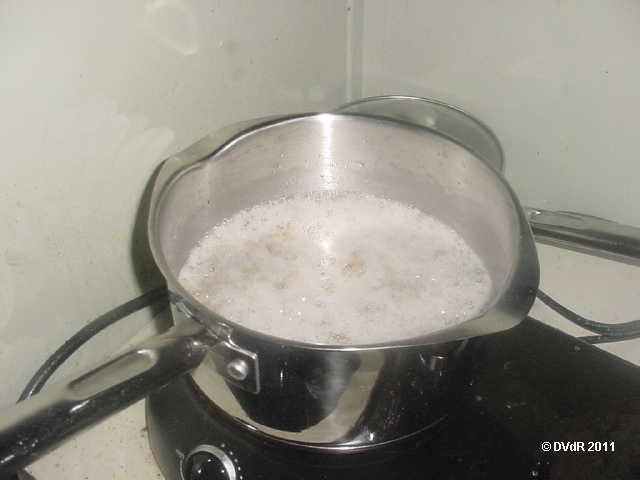
Once the water starts to barely boil, reduce the heat. As the water begins to cook off, it will make a froth on the surface.

As more water cooks off, you can see the fat pieces beginning to brown. At this point, you should start pouring off what fat has already rendered, to keep it from taking on a "cooked" flavor. With the pot shown above, I was side-tracked by the telephone so it all came out at one time. It was actually okay, partly because I chose to only render a small amount of fat.

 |
| The rendered lard is very clear, with absolutely no hint or smell of overcooking. |
 |
| The rendered lard cools to almost pure white overnight. |
I was very pleased with this newest batch of pig back fat that I got from a different supplier of pastured pork. The smell from the get-go was cleaner, fresher... and it rendered much nicer, in my opinion. The technique might have a lot to do with it, too! Unfortunately, that farmer is now out of the pig business. (He sold all his pigs after they broke the fencing and destroyed his enormous garden.)

The next thing I did was to whip some of the rendered lard, a suggestion found on eGullet. Someone there said it makes a lovely creamy consistency. The photo above is after whipping briefly as it was slowly cooling, roughly at about 75ºF. It didn't make much difference, no increase in volume.
However, I've decided not to whip any more of it. Whipping incorporates air, which hastens oxidation. WHAT was I thinking? (Obviously I wasn't thinking or I wouldn't have done it at all!)
The second method I want to post about involves emulsifying, and it's too long to add to this post. Look for it in a week or three, when I've had time to make a batch and take photos.
Saturday, November 20, 2010
Rendering Lard in a Crockpot
It's PIE time, and I need lard for pie crusts!
But, why do we render lard or tallow? Well, rendering improves storage life by removing the impurities, whether bits of flesh, connective tissue, or moisture. Down near the bottom of this post there is a photo of the 'dregs' that did not dissolve into pure lard during the rendering process. (This is more than one would usually have rendering fatback or leaf fat, but that is only because of what I used as the source for fat.)
My earlier posts on rendering have only been on beef tallow from leaf fat. I'm still waiting on my meat man for leaf fat and back fat from hog butchering so I can render some lard. However, Thanksgiving is coming soon, and that means pies... which means some lard for a flakier crust. Frankly, I make lousy pie crusts... but then, I've never made one with lard. Maybe, just maybe, I can make a decent crust with lard!
But, why do we render lard or tallow? Well, rendering improves storage life by removing the impurities, whether bits of flesh, connective tissue, or moisture. Down near the bottom of this post there is a photo of the 'dregs' that did not dissolve into pure lard during the rendering process. (This is more than one would usually have rendering fatback or leaf fat, but that is only because of what I used as the source for fat.)
My earlier posts on rendering have only been on beef tallow from leaf fat. I'm still waiting on my meat man for leaf fat and back fat from hog butchering so I can render some lard. However, Thanksgiving is coming soon, and that means pies... which means some lard for a flakier crust. Frankly, I make lousy pie crusts... but then, I've never made one with lard. Maybe, just maybe, I can make a decent crust with lard!
I had 3-4 pounds of frozen, uncured 'bacon' I ordered when a local meat co-op opened several months ago. I had thought I was getting pork belly to cure my own bacon, but it came thick-sliced instead. So, I am rendering roughly 3 pounds of it for lard, doing a few things different than I what did for the tallow.
One, I chopped the pieces much smaller. Two, I added a cup of water (the tallow was done dry, in the oven), and three, I'm using the crockpot (slow cooker). Someone asked me in a post earlier if rendering can be done in a crockpot, so I'm finding out!


This is after about 2-3 hours in the crockpot, and after I took off some of the liquid fat and water..

I removed part of the liquid (fat and water) and strained it through some cheesecloth. You can see the water at the bottom of the measuring cup.

The lard will turn white when cooled. (I poured off much of the lard into the container at the left, before it was cooled enough to become white and semi-solid.)

There are still some dregs not fully rendered. I put them in a small skillet on a low temp, to see if the meaty bits will "fry", and I can get a little more lard from them. I'll package the remains in small amounts for the freezer as they will make tasty additions to soups and stir-fried greens.
Update: I ended up with one pound of mixed bits of small fat chunks and meat, one and a half pounds total of rendered lard; the remaining half pound of the original weight must have been a combination of water and some fat soaked into the layers of cheesecloth I used for straining. Also, the fat I rendered in the skillet after I strained the bulk of it (about half a pound) had a slight but noticeable bacon odor so I packaged it separately for use where taste doesn't matter. I don't want to make Bacon-Pumpkin Pie for Thanksgiving!
I see no reason lard cannot be successfully rendered in a crockpot, and I'm quite satisfied with mine even though it was uncured bacon slices and not chunks of pork fat. When I do get the pork leaf fat, I'll try some in the crockpot to see if that works equally well.
Wednesday, October 27, 2010
Rendering Beef Suet (Leaf Fat) for Tallow, Again

I finally got more beef suet, aka leaf fat, from my meat man, and as promised, here are photos of rendering it for tallow. I posted on this before, but not with photos as I went along, and photos have been requested since then.
First, the difference in beef suet/leaf fat and regular beef fat. The beef leaf fat or suet from around the kidneys is considered the best fat for rendering into tallow. It tends to be cleaner, with fewer impurities, and more pure fat rather than layers of fat mixed with meat, blood vessels, etc. Certainly, any beef fat can be rendered, as can the fat from ducks, chickens, geese, lamb, hogs... it depends on your use of the fat as they all have different properties both for cooking, and even for soap-making. I just decided to render the beef leaf fat for this post since I got it for free.
Generally speaking, tallow is made from beef fat, lard is made from hog fat. The beef suet or leaf fat from around the kidneys has a much different 'feel' than regular fat also. It is crumbly when you cut it, feels waxy rather than greasy, and has a thin membrane around and sometimes through bits of it.
Generally speaking, tallow is made from beef fat, lard is made from hog fat. The beef suet or leaf fat from around the kidneys has a much different 'feel' than regular fat also. It is crumbly when you cut it, feels waxy rather than greasy, and has a thin membrane around and sometimes through bits of it.

These are the 2 pieces I got, still frozen and just beginning to thaw on the counter. The one sorta balled up was put back in the freezer for now, since I don't have a pot large enough to do both at once.

To render it, it needs to be in small pieces; the smaller they are, the quicker it renders. I trim out any bits of meat I see in it, although this had almost none... some of the bits of fat will cook out as edible beef cracklins'... just sprinkle a little salt or other seasonings on them while they are still warm.

You can see the membrane in the first photo with the chunks up above, but here's a close-up.

Place all the chunks in a large pot or dutch oven and place in the oven set to 300ºF. How long it takes to render is a combination of temperature and size of the pieces. Note: I started rendering at lower temperatures (around 225ºF) last year; it takes much longer.

This is after about 3-4 hours at 300ºF. I turned up the temperature to 325ºF after this photo, partly because I was impatient, and because I'm not sure my thermostat is correct. It's an older stove that was here when we bought the place.

After most of the fat rendered out and cooled just a bit, I strained it into another stainless steel pot, through several layers of cheesecloth lining a metal mesh strainer. Do not use plastic with the very hot fat; it will melt and you will have an enormous mess to clean up!! (The photo of straining was too blurry to post.)
In the disposable pie pan in the back, you can see the pieces that did not completely render. I don't know why, maybe the chunks should have been smaller? Or my thermostat is really out of whack? I don't remember that ever happening with previous batches, but for sure the next batch will be cut smaller. I may even run it through the food processor quickly.
After the fat cooled to about body temperature, I poured the tallow into yogurt containers and refrigerated it to chill completely. As it cools, the tallow will turn white or off-white, and become fairly hard. (See photo at top of post.) I have seen the suggestion of sprinkling half a teaspoon of baking soda over the chunks before cooking to insure a more even color in the tallow, but mine has always been just fine so I've never tried it. Once cooled, the tallow does not need refrigeration, but it should be stored tightly covered in a cool, dry place.
I read somewhere that grass-fed beef tallow, which is naturally low in Omega-6, was the most frequently used household fat in the early 1900's (long before the earliest documented cases of heart disease). So much for saturated fat clogging our arteries! I'll write another post soon on more of the nutritional differences in lard and tallow and maybe other fats and oils as well.
Tuesday, August 10, 2010
Omega 6, Obesity and Type 2 Diabetes
Omega 3 and Omega 6 are lipids... EFA's (essential fatty acids). We cannot manufacture them in our bodies; we must get both of them from foods. We hear a lot about Omega 3 from fish oils, but we seldom hear very much about Omega 6 in anything, whether food sources, news, or health warnings.
It is not only important that we get both Omega 3 and 6 in our foods, but it is very important that we get them in the correct ratios. Research scientists recommend ratios varying from 5:1 to 10:1 omega-6 to omega-3, but some experts suggest a ratio of between 1:1 and 4:1 as being optimal. The average in the US often is between 30:1 and 40:1!
ScienceDaily reports a study now linking excessive Omega 6 coupled with insufficient Omega 3 to increasing obesity in generations, and metabolic disorders like insulin resistance (which is the first step in developing Type 2 Diabetes). Over the last 40 years the amount of Omega 6 we consume has increased over 250%, while the amount of Omega 3 we consume has dropped by 40%, increasing the ratio dangerously.
When the intake of Omega 3 & 6 is unbalanced, it can have serious long-term effect on human health.
When the intake of Omega 3 & 6 is unbalanced, it can have serious long-term effect on human health.
Where do we get Omega 6? Mainly from corn (maize) and wheat, which are themselves consumed in large quantities by the farmed (CAFO) animals eaten by humans. (Half our lipid intake comes from meat and dairy products.) We also get Omega 6 from food oils like palm, soybean, rapeseed (Canola), and sunflower.
I do not believe the Obesity Crisis is just due to eating too many calories, but due to eating too many of the wrong calories. Since I severely cut my Omega 6 intake several months ago to a better balance with Omega 3, I have lost well over 25 pounds even though my daily caloric intake is now higher.
So I have to question why 'they' keep pushing 6-11 servings a day of grain products (Omega 6) on us? Why 'they' keep saying grain-fed beef and grain-fed chickens (mostly from CAFO's) are healthy for us? (Duh. They are cheaper to grow because they are heavily subsidized, and they are highly profitable.)
Friday, July 9, 2010
Cooking with Tallow

Chicken Fried Steak photo from jasonlam's photostream
Cooking with tallow may be something not many of us do, yet it has some terrific advantages. I recently wrote about rendering tallow, so let's talk about cooking with it.
Tallow from grass-fed cows is healthy, with a low omega-6 content and a balanced omega-3/omega-6 ratio, low level of polyunsaturated fats (around 3%), and vitamins like Vitamin A and K2. Tallow has a high smoke point, making it ideal for deep frying, although it's best to keep the temp a bit lower, like 350ºF. Deep frying in good fats is not the health buggaboo it has been 'touted' as being, and in fact research is now proving saturated fats are good for the heart and cholesterol levels. (Personally, I contend that saturated fats from CAFO animals are not ever healthy since toxins concentrate in the fat and organs.)
If you are frying battered chicken, chicken fried steak or onion rings in tallow, some bits of batter may come loose. They could burn, giving the tallow a poor taste, so fish them out as you go along. When you are finished frying, the tallow can be strained for re-use because heat has not broken down the structure (unless you used it in the smoke-point), something you cannot do with most fats. If you have fried something with a strong flavor, just drop a couple slices of potato into the hot oil when you take the pan off the heat. The potato will absorb most of the flavor in the oil.
Strain it carefully while it is still fairly hot. I place a scrap of clean cotton cloth or muslin in a metal strainer to catch any browned bits I didn't fish out. Tallow is hard to clean out of cloth so I just toss it. Try to get as much of the tallow as you can out of the pan... when it cools it becomes like hard wax. I use a paper towel for the last film. When the filtered tallow is thoroughly cool, it will be hard. Cover the container, and store in a cool, dark place for re-use. (I store mine in a 4 cup pyrex measuring cup.)
ps... I'm betting tallow is great to re-season cast iron pans. I have one that needs it, so I'm going to give it a shot. I'll post results later!
I have several pounds of beef leaf fat on order for the next time my supplier butchers, which should be in about 2-3 weeks. As requested, I will post pictures of the rendering process.
Friday, June 11, 2010
Modern Hunter-Gatherer, Part 4: Oils and Other Fats
 Photo courtesy of Suzi Rosenburg's photostream
 Fats and Oils
For the modern hunter-gatherer, merely choosing which fats to ingest can be a problem depending on what/whom you believe. It's a very controversial subject!
If you follow the CW (conventional wisdom) espoused by many authorities (including government food and health agencies), you probably have very few problems in finding the fats touted as healthy (despite recent proven scientific evidence to the contrary). Those fats are mostly manufactured fats, available in all grocery stores; you are advised to keep your fat intake low and avoid all natural saturated animal fats at any cost.
I used to have a Peanuts cartoon I snipped out of the newspaper years ago. Charlie Brown was telling Snoopy about something he apparently didn't want to hear… and at the end, Charlie Brown turned to Snoopy and said, “and DON'T roll up your ears.”
We have been led down a merry path ever since 1911 when Crisco became the first available food product to contain hydrogenated oil. They didn't start out to make a food product, though. The process of hydrogenation, which insures the fat remains solid at normal storage temperatures had just recently been patented to harden oils for use as a raw material for making soap so they made some... and since the material looked like lard, they began selling it as food.
It wasn’t long before hydrogenated oil was incorporated into many other foods, and the increase in use has been consistent with the dramatic rise in the prevalence of obesity, diabetes and heart disease that occurred during the last century. Smuckers, who bought Crisco, introduced in 2004 "Crisco Zero Grams Trans Fat Per Serving All-Vegetable Shortening," which contained fully-hydrogenated palm oil blended with liquid vegetable oils to yield a shortening much like the original Crisco.
As of 2010 Crisco consists of a blend of soybean oil, fully hydrogenated cottonseed oil, and partially hydrogenated soybean and cottonseed oils. Some nutritionists argue that while the formula has been changed to remove the trans fatty acids, the fully hydrogenated oils used to replace them may not be good for health. (See New Fat, Same Old Problem With An Added Twist? Replacement For Trans Fat Raises Blood Sugar In Humans, ScienceDaily (Jan. 18, 2007).
That study, published online in Nutrition and Metabolism, demonstrated the new fats adversely affected human metabolism of lipoproteins and glucose, when compared to an unmodified, natural saturated fat.
Current cumulative research has put to rest the long-held but erroneous concept that saturated animal fats are bad for us, and give us heart attacks. Has that made the national news? Nooooo….
The SAD (Standard American Diet) is high in fully and partially hydrogenated fats and also high in sugars. I’m not sure if it is the lack of media coverage causing even our doctors to still give out advice based on the old information, or if it's also that we collectively have rolled up our ears so we can't hear it.
Meanwhile, I have determined to eliminate from my diet all manufactured fats incorporated in anything labeled ‘food’ with an added bunch of chemical ingredients, or sold as a single ingredient. That was hard to do until I recently stopped buying anything requiring an ingredients label. I don’t eat soybean oil, corn oil, nor canola. I buy only organic, extra-virgin first cold-pressed olive and/or cold-pressed organic coconut oils and real butter, plus I eat lots of saturated animal fats like beef and egg yolks, and fatty fish like salmon.
One thing I will NOT do, however, is eat animal fats from confined factory animals. All the pesticides, herbicides, antibiotics, and hormones they are exposed to end up mostly stored in their fats (and their organs).
Fortunately for my food protocol, hunting and gathering good fats and oils is pretty easy. Most grocers carry butter (although not the most nutritious available, in my opinion and I no longer buy it) and a decent selection of olive oils; reading the label on olive oils is a must. After the first cold-pressing of olives, the remaining pulp is generally washed with chemicals such as hexane to extract more oil, and that bottled oil will state on the label just ‘olive oil’. In fact, some olive pulp is chemically washed as many as 4 times to extract the last drop of oil.
Why do I prefer cold-pressing?
When olives are pressed by mechanical action, the friction produces heat, and heat destroys enzymes (and other nutrients in the oil by increasing oxidation) resulting in a lower quality oil. Likewise, centrifuge extraction causes similar damage to cell walls in vegetable fats just as it does in milk fats. Only in the EU is strict adherence to olive oil regulation standardized, and enforced; few other countries have any such regulations. So I am assured by buying Spanish, Greek or Italian extra-virgin cold-pressed olive oils that I am getting the real thing.
Finding good saturated animal fats goes hand-in-hand with finding grass-fed, pastured meat animals and eggs and I covered that in Part 1.
Subscribe to:
Posts (Atom)