Showing posts with label Herbs. Show all posts

Thursday, April 5, 2012

Starting herbs for edible food forests

One of the basic necessities for an edible food forest is drawing in both the pollinators and the beneficial insects that keep the predators under control.  Some folks call these insectary plants. The "friendly insects" include ladybeetles, bees, ground beetles, hoverflies, and parasitic wasps. Other animals that are frequently considered beneficial include lizards, spiders, toads, and hummingbirds. 

Beneficial insects are as much as ten times more abundant in the insectary plantings area. Elimination of scale insects double with insectary plantings. Additionally, a diversity of insectary plants can increase the population of beneficial insects so much that these levels can be sustained even when the insectary plants are removed or die off.

Many members of the Apiaceae (formerly known as Umbelliferae) family are excellent insectary plants. Fennel, angelica, coriander, dill, and wild carrot all provide in great number the tiny flowers required by parasitic wasps. Various clovers, yarrow, and rue also attract parasitic and predatory insects. 

Low-growing herb plants, such as thyme, rosemary and mints provide shelter for ground beetles and other beneficial insects. Composite flowers like daisy, chamomile and mints will attract predatory wasps, hoverflies, and robber flies. The wasps will catch caterpillars and grubs to feed their young, while the predatory and parasitic flies attack many kinds of insects, including leafhoppers and caterpillars.

I have many of these insectary plants (which are now big enough to be divided this year) already in my garden, but as I expand my planting areas, I need more plants I don't already have for both the new and old areas. So, I started seeds of some herbs. Not all are insectary plants, but if not, they will still attract pollinators so it's a win-win.

New herb starts include:

garlic chives
fenugreek
green shisho (perilla), which is also edible
Mrs. Burn's lemon basil
borage
summer savory
sweet marjoram
sweet basil (old seeds, not expecting anything much to germinate)
An Italian basil a friend sent 3-4 years ago, (old seeds, not expecting anything much to germinate)
lemon bee balm
catnip
wormwood 
tall purslane
anise

I have a flat of bulbing Florence fennel I started a month ago, and last fall it looked like my dill had reseeded everywhere. The yarrow has grown enough since last spring to divide several times, as has the mint and anise hyssop.

I have chamomile seeds to start, and plenty of 2-3 varieties of shasta daisy's to divide for new guilds. My recent trip to Edible Landscaping brought me a couple of trees that can be an anchor in new guilds, but mostly I bought some fruiting vines and shrubs I wanted. I have great hopes for the fruit tree cuttings I have in mini-greenhouses but I'm not holding my breath since I'm new at rooting cuttings.

It's an adventure, for sure!

Friday, December 16, 2011

Antibiotic Spices

Many of us use certain spices for their antimicrobial activity; I know I use garlic and onions a LOT in my lacto-ferments... and I know that other spices have some degree of antimicrobial properties, but I've never had a clear picture of which ones, nor how much benefit is available. Given that many pathogens now come packaged with our industrialized foods like fresh produce, I thought the information might be helpful.

Cornell University did a survey on food-spoilage microorganisms and spices a few years back. The news release about the survey is here. (Full report: "Antimicrobial Functions of Spices: Why Some Like It Hot," Jennifer Billing and Paul W. Sherman, The Quarterly Review of Biology, Vol. 73, No.1, March 1998.)

"Garlic, onion, allspice and oregano, for example, were found to be the best all-around bacteria killers (they kill everything), followed by thyme, cinnamon, tarragon and cumin (any of which kill up to 80 percent of bacteria). Capsicums, including chilies and other hot peppers, are in the middle of the antimicrobial pack (killing or inhibiting up to 75 percent of bacteria), while pepper of the white or black variety inhibits 25 percent of bacteria, as do ginger, anise seed, celery seed and the juices of lemons and limes."

Top 30 Spices with Antimicrobial Properties
(Listed from greatest inhibition to least inhibition of food-spoilage bacteria)

1. Garlic
2. Onion
3. Allspice
4. Oregano
5. Thyme
6. Cinnamon
7. Tarragon
8. Cumin
9. Cloves
10. Lemon grass
11. Bay leaf
12. Capsicums
13. Rosemary
14. Marjoram
15. Mustard
16. Caraway
17. Mint
18. Sage
19. Fennel
20. Coriander
21. Dill
22. Nutmeg
23. Basil
24. Parsley
25. Cardamom
26. Pepper (white/black)
27. Ginger
28. Anise seed
29. Celery seed
30. Lemon/lime

Wednesday, July 27, 2011

Freezing Culinary Herbs

Last year I dehydrated my chives before frost killed them all. They were tasteless when I cooked with them... Bleck!

This year I decided to freeze as many of my culinary herbs as I can IF they do well frozen, or at least do better than dried. In general, I prefer not to rely on the freezer for food preservation, and have managed to whittle down what I do freeze. However, I enjoy cooking with herbs so my winter options are limited since none are available in my garden after the first hard frost. Nor do I have an available windowsill to grow them inside over winter.

So far my frozen list includes basil, chives, thyme, flat leaf parsley and rosemary, but I may also freeze dill, oregano, marjoram, sage and tarragon as the summer wears on. Fresh frozen herbs are used in the same amounts as fresh herbs, whereas dehydrated herbs tend to have concentrated flavors and require a lesser amount. (Parsley is the exception... dried parsley has no taste at all in my opinion.) Frozen herbs will NOT be suitable to use as a garnish, as they will be wilted after thawing.

Opal Basil, chopped and in water
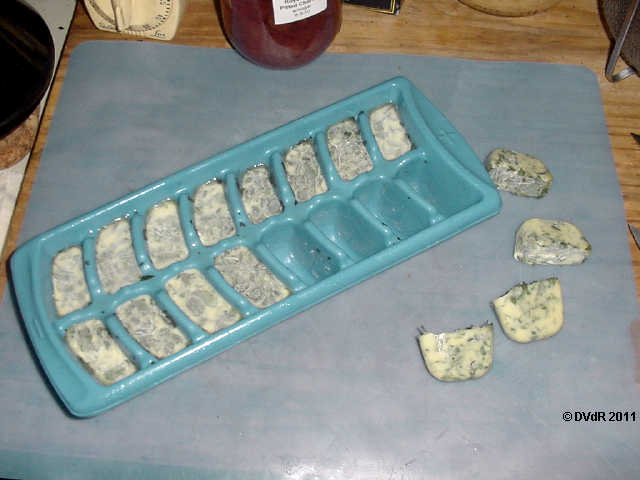
There are a couple of ways to freeze herbs. If you would like cubes to just drop into a dish, you can freeze them in water in an ice cube tray... but there's a trick to it. Chop the herbs by hand or in a food processor, and put some in each cube. Then add water BUT only half-way full. (The herbs will have a tendency to float.)


Freeze the tray, then after it's frozen, add enough water to fill the cubes to cover the herbs. Refreeze, and when solid, remove to an airtight container, label, date, and store in the freezer.


You can also use olive oil instead of water, as I did with the spicy globe basil in the photo above. I chopped the basil in my mini chopper with EVOO, filled the cubes and froze in one pass. They are back in the freezer to get very solid, and them I will vacuum-seal them, just 3-4 per bag so I'm not opening many at once for use.

Here is another option, and less messy: I'm choosing to freeze many of my fresh-cut herbs in thin layers on a cookie sheet, then vacuum-seal in small portions not more than 1/4" thick. That way I can pick out a section to use, and chuck the rest back in the freezer awaiting their inclusion in another fabulous dish!


I like to use sprigs of thyme rather than thyme leaves in many dishes, so I opted to freeze thyme in short sprigs, and vacuum-sealing small amounts of frozen sprigs. Same for rosemary. When rosemary is frozen on the stem, it it much easier to remove the needle-like leaves to chop if that's your preference.


Chives... What you see on the cookie sheet above was a clump of fresh cut chives about 1-1/2 inches in diameter before I trimmed the tiny thin ends and snipped them. (Much more than in an expensive fresh-pack at the store, by quite a lot.)


I found that taking the frozen snipped chives from the freezer (on the jelly-roll sheet) to take a photo allowed them to thaw just enough to be slightly wet. So I put half in each bag and refroze before trying to vacuum-seal.


After with the experience of the chives thawing while trying to take a photo, I decided to snap a photo of the flat leaf parsley leaves IN the freezer! (They are on 3 mesh dehydrator screens, stacked.) You will notice I snipped most of the stems off.


The parsley did much better that way, staying frozen for the few moments it took to vacuum-seal them.

Harvesting portions of my herb plants in mid-summer encourages the plants to generate new growth, and I will have more to put by later on... and still plenty to use fresh now.

Note: I froze some of the opal basil flat like the thyme (as well some in water cubes) for some comparisons later this winter.

Friday, June 4, 2010

Ignoring the Obvious in Supplements?


The FDA is trying to crack down on supplements... which is becoming a political hot potato. In recent years, the vast majority of supplement manufacturers and suppliers have relocated overseas, mainly in China. For example, nearly all the Vitamin C, along with many other popular supplements sold in the US, comes from China. The FDA is not required to inspect those plants on foreign soil, and has little funding to do so anyway.


A report from a company that has tested over 2,000 dietary supplements made by more than 300 manufacturers and has found that one in four have quality problems. The 'quality' problems are trace elements of contaminates like lead, pesticides and heavy metals — including mercury, cadmium and arsenic — which did not exceed thresholds (except for the pesticide residues) considered dangerous, the investigators found.

So, what does that really mean?

The FDA wants to  use that data as part of their ongoing efforts to make it necessary to have a physician write all prescriptions for any vitamin and herbal supplements.


Herbal supplements are made from dried and processed herbs, and how they are grown and in what soil controls the quality, in the US or a foreign country. Sure, quality can also be affected by conditions in processing but probably most originates in the field. There are pesticides and herbicides still being manufactured in the US which have been outlawed as toxic for any application in the US, but the manufacturing companies are still allowed to sell them to foreign countries. When other countries apply those products to crops, naturally they show up in the soil and thus the plants, which absorb them from the soil.

It seems to me the FDA should concern themselves more about eliminating the source of contamination (stop the production of toxins), and support the quality herbal manufacturers in the US. Instead, it seems they want to outlaw all supplements unless a doctor prescribes them, which will punish US herb growers and consumers alike.

We have choices when we purchase vitamins and herbal dietary supplements, but choosing which brand is not necessarily an easy decision. Do we buy the cheapest brand with the best safety advertising buzz words? Most of us probably do. Do we bother to look up each company to see where their raw material is grown? Probably not. Do we ask if their ingredients are certified organic, thus free of pesticides and heavy metal contamination? Probably not.

I just looked up the manufacturers of the D3, C, and magnesium I take. Only one lists a materials source (India); one shows the parent company is in China, and all say the have a packaging facility is in the US. That doesn't tell me where all their raw materials originate.

When I still lived in North Carolina, I had the opportunity to visit the farms of Gaia Herbs. They have recently instituted a traceability program for their herbal supplements, and from what I saw of their farms I would trust the integrity of their products. Many of their herbs are grown under very strict organic standards and advertised as such. (I do not work for them, nor do I receive any compensation from them. Their inclusion here is merely an example of what is possible.)

Another choice we have is to eat foods high in nutritional value, assuring our necessary vitamins come from real foods and not a questionable pill. If we can get all our nutritional needs met and our body re-balanced and our stress levels reduced, we may find we won't need the healing powers of herbal medicines as much. 'Course, herbs still make great tea!

Sunday, July 26, 2009

Lemon Cream Puff Filling


I am making a light lemon whipped cream filling for my cream puffs, since it's summertime and hot weather prevails! After reading Chef Di's recipe for blueberry muffing with lemon balm, I got the bright idea to add a few finely chopped fresh lemon balm leaves, and use a few for a garnish.

Lemon Whipped Cream
1 cup well-chilled whipping cream
2 tablespoons powdered sugar or superfine sugar (bar sugar) to taste
1 tablespoon finely chopped lemon balm leaves
2 teaspoons fresh lemon juice, to taste

Whip the cream to soft peaks, add the sugar, lemon juice and lemon balm and whip until a bit stiffer. Slice open cream puffs, add the filling, put the top back on and dust with powdered sugar.

I have a heavy glass container I always use for whipped cream except I cannot find it right now. It's actually the container from an antique cream churn, but the glass is very thick and stays cold longer than most containers. (Originally it had a lid with built-in egg-beater style paddles.) The hand mixer blades fit in it nicely and whipping cream doesn't take much effort to whip with a hand beater.


I put the glass container in the freezer while the cream is chilling. When I make whipped cream for pumpkin pies at Thanksgiving, I freeze the glass jar for at least an hour, then add chilled cream, cover and refrigerate (not freeze) at least another hour before whipping. Since this filling today will go immediately into the cream puffs, I'm just using my stand mixer.

Monday, June 22, 2009

Provençal Vinegar

Since I posted my recipe for Raspberry Vinegar, I thought I make and post my favorite homemade vinegar, Provençal Vinegar. This is a great salad vinegar, and also used in place of a splash of lemon juice in many meat and vegetable recipes.

The recipe says it keeps 6-9 months; that's probably a good age for culinary use as the taste and smells meld and intensify with age. I have had a bottle on the kitchen windowsill for 2-3 years and although I don't cook with it, I often just take a whiff to get my salivary glands going!


Place in each of 2 small glass bottles:


From the herb garden:
1 sprig fresh thyme

1 sprig fresh rosemary

1 small bay leaf

From the pantry:
1 large clove garlic, peeled

1 piece of lemon zest, cut long and narrow to curl

Champagne vinegar to fill each bottle


Thoroughly wash herbs and let them air dry.

Place the herbs, garlic and lemon zest in a sterilized bottle.

Pour in the vinegar to completely cover the lemon herbs and zest.

Seal, label and store in a cool, dark place for about 1 month before using.


This vinegar will keep for about 6-9 months stored in a cool, dark place... and only gets better with age!


NOTE: The garlic clove may turn blue/green. DO NOT BE ALARMED! It is perfectly safe. (Garlic is saturated with a chemical that turns garlic green or greenish blue when released by the acetic acid in the vinegar. The pigment in garlic itself turns out to be a close chemical relative of chlorophyll, which gives all green leaves their color.)


I have been known to first warm the herbs and citrus peel (but not the garlic) in the vinegar to almost a simmer, discard the herbs and peel and pour the vinegar over fresh herbs and peel (plus garlic) in the bottles. It kinda jump-starts the blending of flavors!