Showing posts with label Made from Scratch. Show all posts

Sunday, December 22, 2013

Chicken and Superbugs

In case you have just wandered onto this blog on a whim or random Google link, let me be clear about my food choices. I NEVER buy meats from the grocery stores, and not much produce except in winter when there’s no local hoophouse stuff available. I do as much home-grown and/or organic as possible.

My health is not good (stemming from years of work-related causes) but I'd probably be dead already if not for my food choices over the last few years. 

When I say I buy no commercial “no meats” I really mean it, but especially NOT any chicken. Here’s one reason why:

Tyson chicken houses are everywhere in Virginia, but thankfully none are very near me. They are now making biochar from the Tyson waste and I won’t even buy that for my garden. Yuck. Instead I use the charred bits from my wood stove on my garden.

I buy local organic grass-fed meats despite the higher cost, and I believe (in addition to being tasty) it benefits my health, plus cuts down my health-care costs. I cure my own bacon from domestic hogs that roam our wooded mountain slopes, and make my own butter from local cream that's not ultra-pasteurized. I also make a lot of my own cheese. Occasionally when I get off the mountain to a large city, I look for wild shrimp and fish but those gets harder to find every year. 

If you've tread much about native american and early settler life, you know they ate the organs of meat animals long before they'd eat the muscle meats. That's because the organs contain so much more nutrition that the muscles. We Americans choose less nutritious steak instead of organ meats, sacrificing nutrition for popular belief.

I admit I balk at eating brains, although my dad loved them scrambled with eggs. I eat liver, kidneys, heart, and sweetbreads. Some of the tougher cuts like hearts and kidneys sometimes get ground and used in a mixed country paté loaf. Do NOT even mention chitlins or tripe because I'm not going there!

Friday, March 1, 2013

Duck Feet


In the past, I have used chicken feet in stock because they give off a lot of gelatinous material that is high in glucosamine and chondriton. Great stuff for our joints and bones, and they give a bit of body to stock.

Recently in a nearby Asian market,  I found frozen duck feet that had been skinned and had the nails cut off so I picked up some for just gelatinous stock to add to soups, stews or whatever. They add the same benefits as chicken feet, but I didn't have to skin and declaw them myself.

I cooked these in a crock pot about 6-7 hours, and then pressure-canned them in 4 oz. jars. Just one jar (or even half a jar) makes a great addition to any soup or stew, and doesn't add any flavor.

Tuesday, December 18, 2012

Liver Disease and Nutrition

Six and a half years ago, I was diagnosed with Liver Disease, and referred to the University of Virginia to see some liver specialists. The first thing they did was to refer me to the Transplant Program, where I underwent a battery of tests over several months to determine if the rest of my body was healthy enough to withstand the rigors of a liver transplant.

At the time, I was also having the same intermittent low thyroid symptoms I'd had for most of my life. I show all the symptoms of hypothyroidism, yet the thyroid tests always come back in the normal range. This time, the endocrinologist talked to me about foods that adversely affect the thyroid, most notably cruciferous vegetables and soy products. They are goitrogens, meaning they suppresses thyroid function and the uptake of iodine needed by the thyroid.

Cruciferous vegetables lose a lot of the goitrogens when cooked, but soy does not. I thought I had pretty much eliminated soy from my diet years ago... that is, until I discovered soy masquerades under 40 or more names as food additives. The first thing to eliminate from my diet was any food that came in a package with a long list of chemical ingredients on the label, many of which are soy-based (and from GMO soy).

The next thing to eliminate was sugars, high fructose corn syrup in particular. Fructose damages the liver and causes mitochondrial and metabolic dysfunction in the same way as any other toxin.

Sucrose (table sugar) is 50 percent glucose and 50 percent fructose. High fructose corn syrup (HFCS) is anywhere from 42 to 55 percent fructose depending on which type is used. Glucose is the form of energy our bodies are designed to run on. Every cell in our body uses glucose for energy, and it's metabolized in every organ of our body; only about 20 percent of glucose is actually metabolized in our liver. Fructose, on the other hand, can only be metabolized by the liver, because the liver is the only organ that has the transporter for it. 

Since all fructose gets shuttled to the liver, when we eat a typical Western-style diet, we consume high amounts of it, so fructose ends up taxing and damaging the liver in the same way other toxins (including alcohol) do. In fact, fructose is virtually identical to alcohol with regards to the metabolic havoc it wreaks. 

According to Dr. Lustig (an endocrinologist at the Univ. of California), fructose is a "chronic, dose-dependent liver toxin." And just like alcohol, fructose is metabolized directly into fat—not cellular energy, like glucose. So when eating fructose, it just gets stored in our fat cells, which leads to mitochondrial malfunction. 

The liver is the major site for converting excess carbohydrates and proteins into fatty acids and triglycerides, which are then exported and stored in adipose (fat) tissue.  I was advised to cut my carb intake to 50 grams a day until my system got clean, and then keep the intake to under 100 grams a day. 

The last thing to eliminate was any meat and eggs from animals that may have been fed the same soy and grain I was to avoid, as well as avoiding all fresh produce grown in a chemical cloud. That meant local free-range eggs, grass-fed beef, lamb, pastured pork, free-range chickens, and the Farmer's Market for veggies I don't grow.

Well, let me tell you, for 2-3 weeks I thought I would starve to death! Giving up the obvious addictive sugars was hard enough, but giving up bread and pasta was even worse. That's when I really started to delve into Real Foods, and things started to turn around.

Within a month, my energy levels and mental outlook began to increase, and my liver enzymes improved enough in 3-4 months that my liver docs took me off all meds.

I also began to lose a little weight. I learned to always carry a wholesome snack when I was away from home, usually a hard-boiled farm egg, or a piece of raw milk cheese (for the enzymes not found in pasteurized cheese). (Do not believe raw milk cheese might harbor pathogens. By Law, they must be aged at least 60 days before they can be sold, and if there were pathogens, the cheese would be rotten before the 60 days were up.)

Unfortunately, I have fallen partially off the "good diet" wagon over the last 12 months, mostly due to the increased cost of food and utilities versus my income (just a monthly social security check) and partly due to laziness. Eating right requires planning ahead and making time to prepare nutritious foods. In the last 3 weeks, I've had 3 sodas because I was experiencing low blood sugar while away from the house. That's 3 more than I've had in 5-6 years.

It's time to climb fully back up on that healthy food wagon no matter what else I have to give up. (Or continue a downward spiral in my health.)

There are many, many good things I can make from cheap cuts of meat and bones. Slow cooking a crockpot full of bones produces an incredibly nutritious broth/stock that's like jello when cooled.  Stock contains minerals in a form the body can absorb easily—not just calcium but also magnesium, phosphorus, silicon, sulphur and trace minerals.  Bone broth also supports joints, hair, skin and nails due to its high collagen content. In fact, some even suggest that it helps eliminate cellulite as it supports smooth connective tissue.

Cooked long and slow, bone broth also contains the broken down material from cartilage and tendons, stuff like chondroitin sulphates and glucosamine, now sold as expensive supplements for arthritis and joint pain.

The "odd bits" like heart, liver, kidneys, sweetbreads, etc. contain so much more nutrition than the muscle meats, and they are much cheaper to purchase. I just received a Christmas gift of the book Terrine, plus I found a used copy of Terrines, Påtes and Galantines on ebay for under $4 earlier this year. (If you are not familiar with terrines, think meatloaf... and a galantine is just a meaty loaf encased in a pastry shell.)

What else did I eat when I felt so great?? Bacon, eggs, sausage, homemade yogurt, salads dressed with fresh lemon juice and a drizzle of EVOO, cheese, real butter, real cream in my coffee (not UP), fresh veggies, olive oil and coconut oil, sardines, not much fruit because of the sugar content, no legumes, no grains, and grass-fed meats daily. My one daily treat was a half-inch square of an 85% cacao bar at bedtime, and it was enough.

Eating those foods also brought the ratio of my Omega-6 to Omega-3 back into a better balance (about 4:1) than the SAD (Standard American Diet) which is as much as 40:1. 

All the meat and dairy provided the essential amino acids necessary to build proteins (essential because our bodies cannot produce them internally). The failure to obtain enough of even 1 of the 10 essential amino acids has serious health implications and can result in degradation of the body's proteins. Muscle and other protein structures may be dismantled to obtain the one amino acid that is needed. "Unlike fat and starch, the human body does not store excess amino acids for later use; the amino acids must be in the food every day.

I bought some wonton wrappers yesterday and intend to make and freeze some wontons (they contain just 4 grams of carbs per wrapper). A lunch of a wonton or two added to some home canned stock is quick, easy, and nutritious. 

It's a start. Salads will be scarce over the winter because I'm leery of bagged greens, even organic ones. Thankfully I froze lots of green veggies from my summer garden.


Wednesday, March 14, 2012

Apple Pie from scratch


"To make an apple pie from scratch, one must first invent the Universe."
~Carl Sagan

Friday, February 17, 2012

Making Duxelles, Essence of Mushrooms

Duxelles is a finely chopped (minced) mixture of mushrooms, sautéed in butter and reduced to a paste. A bit of duxelles can be used in almost any dish, from an omelette to Beef Wellington... any place a bit of concentrated earthy mushroom flavor will add punch to the recipe.

Some folks add onions, shallots, and/or herbs when making duxelles. Since mine are to be frozen in cubes to add a mushroom flavor to some future dishes, I opted for James Beards' recipe that is just mushrooms and butter. That gives me the option to always add shallots and various herbs to whatever recipe I am making.

Since fresh mushrooms are not commonly available in my local markets, I tend to buy mushrooms whenever I'm out of town... and usually with no recipe planned in mind. As a result, I often waste part of the fresh mushrooms because I didn't get around to using them all before they got slimy. Occasionally I have canned a few fresh mushrooms, which by the way make great mushroom soup, but that's a LOT of work if you have only a few mushrooms!

However, turning fresh mushrooms into duxelles that I can freeze in cubes will give me lots of that wonderful concentrated mushroom taste to add to recipes. Frankly, I'm told they lose a tad of their punch in freezing, but they will also last for 2-3 weeks just refrigerated. I'm choosing possibly less than perfect mushroom taste over NO mushroom taste!

Since all the prep (chopping to a mince) for duxelles is a LOT of work, I bought 4 pounds of baby bellas to make a big enough batch that may last me several months.

Here's the recipe I used, followed by some of my photos of making duxelles. I've had the recipe for years and unfortunately, I don't have the recipe source...

Chop Away for Lovely "DUXELLES" by James Beard

I'm often surprised to find how few of my students are familiar with duxelles. It is one of the simplest and most versatile mixtures that you can have on hand in the refrigerator.

Despite the exotic name, which is derived from that of the Marquis d'Uxelles, whose chef invented the special way of cooking mushrooms. It is idiotically easy to prepare, provided you don't mind expending a little energy in chopping. Duxelles is nothing more than finely chopped mushrooms cooked down slowly in butter until they become a dense, dark mass, almost a paste, marvelous for adding concentrated flavor to any- thing from soups to stews to sauces and stuffing.

To make a reasonable amount worth the effort of all that chopping, buy two to three pounds of mushrooms. They don't have to be large, perfect, spanking white caps. They can be small, varied in size and a bit discolored. The taste is what matters, not the appearance, so you can buy those slightly overage mushrooms that are often reduced for quick sale in supermarkets.

Pick the mushrooms over, wiping off any dirt or bits of straw with a damp paper towel, then put them on a board and slice them, stems and all. (The slices need not be even; this is just so they are easier to chop.) I like to use a large heavy-bladed French chopping knife or a Chinese clever, because the chopping goes faster with a big blade. I don't recommend chopping them in a food processor -- they get too mushy.

Chop the slices by hand until the pieces are fairly fine, then put them in a sturdy dish towel, a piece of muslin or several thicknesses of cheesecloth, pull up the corners and twist the fabric into a bag so the mushrooms are pushed into a tight ball.  Then twist and squeeze as hard as you can with your hands to make them yield up a goodly amount of their liquid. It takes a good deal of force to extract as much liquid as possible, but keep on squeezing over a bowl until they seem comparatively dry.

Save the liquid for vegetable soup, a brown sauce or a stew that would be enhanced by a slight mushroom flavor. The point of this squeezing is that the mushrooms will cook down faster if there isn't a lot of excess liquid to evaporate.

Now melt one stick (a quarter-pound) of unsalted butter in a heavy 7- or 9-inch iron or stainless steel skillet over medium-low heat, open the cloth and tip in the mushrooms. Stir the mass with a wooden spoon to break it down and distribute it over the pan.

As they cook down, the remaining liquid will evaporate and the color will become very dark, almost black. This may take 30 minutes or more, and it is a process that you can't hurry.  When you have a thick, reduced mass that holds together, season to taste. Usually I don't add salt, only about eight to ten grinds of pepper, because it is my feeling that duxelles should be salted only as needed when it is added to a dish.

Transfer the duxelles to a crock or bowl and cool -- take a taste and you'll marvel at the intensity of that rich, buttery mushroom flavor -- and then cover with plastic wrap and store in the refrigerator. Duxelles will keep for 10 days to two weeks under refrigeration.  It can be frozen, of course, but to my mind it loses something in the process.  However, better to freeze than leave to spoil, so use your judgment as to how quickly you'll use it up.

This glorious mixture has infinite uses. You can add it to soups, sauces, scrambled eggs; use it as a filling for omelettes and crepes; mix it in stuffings; swirl it into mashed rutabagas, turnips, celery root , potatoes or winter squash; combine it with peas; or spread it on toast, heat and serve as an hors d'oeuvre. The taste is so fantastic, the very essence of mushroom, that you'll find yourself dreaming up more and more possibilities.

There are different flavor variations for duxelles. You can add six or seven finely chopped shallots to the butter just before putting in the mushrooms, mix the two well and let them cook down. Or put six or eight peeled whole shallots or three or four unpeeled garlic cloves in with the mushrooms after they have started to cook, stir them around and remove them after the duxelles is cooked, which gives a slightly less assertive, but pleasant flavor.

One of my favorite ways to use duxelles is as the base for a quick, rich sauce for eggs, vegetables, poached fish filets or poached chicken. Combine one-half to one cup duxelles and one-half cup or more heavy cream in a saucepan and heat, stirring until it just reaches the boiling point. If you like, add about two tablespoons Madeira or a tablespoon of Cognac and heat until the spirit evaporates, leaving only the flavor.

So don't be put off by the name. Once you've made duxelles and discovered how great a flavoring it can be, you'll wonder how you ever cooked without it. 

Okay, here are my photos...
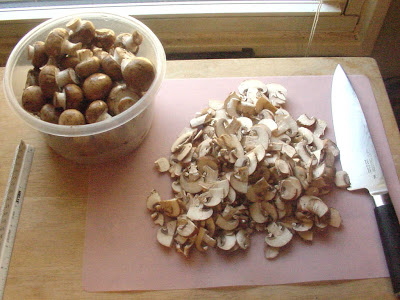
Slicing mushrooms

I discovered I could only mince a small portion at a time... I'm a messy chopper!


Mr. Beard says to squeeze out excess mushroom liquid. I failed with the first pound.

First pound cooked to almost nothing!

For the second batch (3 pounds), I chose to mince the mushrooms in my mini-chopper even though Mr. Beard says it produces a less than perfect texture. First, mincing a pile of mushrooms is a LOT of work, and secondly... when they are cooked into almost a paste, who can tell??
Second Batch (2 pounds) from the mini-chopper
I did a bit better on squeezing the second batch... probably got almost 3/4 cup of liquid, but they still gave off a lot more once in the heated pan. It takes a tremendous of upper arm/hand strength to squeeze the moisture out... I should have invited a weight-lifter! (Not getting the mushrooms dry enough just means more time cooking to release all the moisture before it cooks down into a paste.)

Cooking Down Duxelles

Here's the most amazing thing about this process... the first batch cooked and cooked and cooked (because they were so wet)... and finally all of a sudden the room was filled with the most amazing, potent mushroom smell... minutes before they were ready!! The second batch (and larger, 3 pounds) is cooking now as I'm writing this, but I expect I will know just by the smell when they are almost ready.

Mushroom Juice, and Duxelles from 4 pounds of mushrooms

I filled ice cube trays with the cooled duxelles (and also some of the squeezed-out mushroom juice, lower left) and froze them. I'll bag and vacuum seal 2-3 cubes together for the freezer. 11 cubes doesn't look like much for 4 pounds of mushrooms, but it's concentrated goodness, ready for some future meals! YUM!!

Note: For best mushroom results, please purchase only mushrooms with tightly-closed gills (the underside of the cap) which show freshness; if the gills are open, they are well past their prime. Store them in a brown paper bag in the crisper for best keeping.

Friday, February 3, 2012

Dem bones, dem bones, dem soup bones...


I've been thinking a lot about bones lately... not bones as detritus, but the magical gifts they hold with their exceptional nutritional value, decorative use, and historical use as tools.


Bone House Fence and Gate Bone Details


There's even a Bone House (thanks to the tip from Gaias Daughter) using bones as architectural details! Regardless of their decorative appeal and usage as tools, bones also hold significant nutritional value.


Too many people throw away the bones from whatever meat they ate, whether the chicken carcass, their steak bone, or the pork chop bone. Yet those bones actually hold more nutrition than the meat eaten off those bones!
 
Nutrient-dense stock is chock full of minerals that every body needs, not the least of which is calcium, but also magnesium, phosphorus, and trace minerals. Our bodies easily absorb the minerals and amino acids from good stock or broth used in soups, stews and sauces. They also help us to efficiently utilize protein. Nutrient-dense stock has been indicated in helping to heal rheumatoid arthritis, gastritis, colitis, Crohn's disease, allergies, and other digestive and bone disorders. 

The silky-smooth, wobbly gelatinous stock from bones has been an essential ingredient in savory foods, preferred by cooks all over the world for centuries. (You don't really want to know how they hydrolyse the bones to make the commercial broths sold in grocery stores.)

It takes very little except time to release those goodies from the bones: cover with water, add a tablespoon or two of fresh lemon juice or vinegar; cover and let sit for an hour for the acids in the vinegar to start work on the bones, then simmer long and slow. The vinegar or lemon juice taste will cook off, and leave the bone minerals behind in the broth. I use about 6-8 quarts of water to 2 or more pounds of bones, simmered down to about half the volume when finished. Bones from younger animals give up their goodies quicker... like a fryer chicken vs an old stewing hen, although the old hen will have more collagen and flavor. 

The other great thing bones give us is the gelatin that cooks out of the joints and connective tissue (collagen) with long, slow cooking. This gelatin contains chondriton and glucosamine, which help lubricate our joints, and build strong bones. Keep in mind, though, that overcooking (like more than 12 hours) will break down all that lovely gelatin. I enhance the gelatin content when I am cooking bones by adding chicken feet if I have them, or pig trotters, and often make Fergus Henderson's Trotter Gear just to have some little jars in the freezer to give body and a nutritional boost to a sauce, soup or stew. 


Marrow Bones, photo by Allerina & Glen MacLarty

Roasted Marrow Bones, photo by rvacapinta


I participate in a chatty thread (on a gardening site) that discuss foods and recipes, and recently we talked about the dearth of marrow bones in this country. Some thoughts included ➀ many younger Americans don't know what to do with marrow bones, ➁ there's a big ag market for bone meal, and ➂ we now buy more boneless rather than bone-in cuts than previous generations. We all agreed it is hard to find marrow bones in most markets.

I don't think I've ever had the pleasure of scooping marrow out of a roasted bone; it isn't part of my culture like it is across the pond. Who knew there are marrow spoons??


As far as where the bones from the slaughter houses go, I can attest to both #1 and #2 above. I know the tri-county meat packing house near here sells the bones, as well as the offal, hides, horns, hoofs and other scraps. I'm sure the soft tissue waste goes into pet foods, and I'm inclined to think the other stuff is sold to make commercial gelatin and bone meal. I don't even like to think about it!


On the healthy side, whatever kind of bones you have, you are missing a very nutritious addition to your diet if you don't cook them down for yummy homemade stock!

Monday, January 16, 2012

My Sausges, and more


Recently I spent the better part of a several hours daily making several kinds of sausage patties to freeze. It's nice to know exactly what is (and what isn't) in my sausage: free range meat, no hormones, no GMO's (even in their feed), and only organic herbs and spices. I posted pics earlier of the chicken-feta-spinach sausages, but here's a photo above (Yes, I know I am not a good photographer!) of the whole kaboodle. There are around 80-90 patties in the mix shown above, and that should keep me in sausage for several months. Plus I have enough venison to make another 60-75 patties. I'm short of home cured bacon, but hope to remedy that in February or March.

Next (after I eat up lots of frozen left-overs) is learning to make some terrines and pâtés out of all the odd bits in my freezer. I have several beef and pork hearts, plus beef, pork and chicken livers, some sweetbreads and a few trotters. Hey, how hard can it be to make a "meat" loaf??

Making rillettes is also on my list. I can't imagine that will be too hard... after all pulled pork is simply a slightly altered offspring of rillettes.

Friday, December 2, 2011

Traditional French Onion Soup

Michael Ruhlman posted this Traditional French Onion Soup over on his blog recently. It is made without a beef stock base, and I wanted to try it for a weekend party because we had a vegetarian in our group. Let me tell you, it is a great tasting soup! I liked it better than the typical French Onion Soup made with canned beef broth... but to be fair, I've never tried the stock version with homemade beef stock.


I made a double batch to take to my pre-Thanksgiving vacation weekend with friends. The pot of onions shown above is just the start of one batch, about 5 pounds of Vidalia onions in the pot, which is what I had on hand, rather than Spanish onions the recipe calls for. Vidalia onions are sufficiently sweet for this soup, although not always available all year long.


The onions cook down slowly in a bit of butter. Here's what they look like (above) after 6½ hours at a low simmer.

The next step is to slice and toast some baguettes or french bread, and grate half a pound or more of Emmanthaler or Gruyére cheese. Set the toasted bread rounds and cheese aside, and preheat the broiler.

To the pot of onions, add the water and sherry, bring up to high heat, and adjust seasonings to taste. Fill oven-proof soup bowls with soup, float the baguette slices on top, cover with a generous amount of grated cheese and stick under the broiler to melt and lightly brown the cheese.


In all our dinner hubbub, no one took photos if the individual bowls as they came out of the oven, but the photo on Ruhlman's blog is great.

Serve immediately. YUM!