Saturday, June 11, 2011

Berries (and maybe nuts) fruiting soon!


I planted 3 Nanking Cherries 3 summers ago, mainly to divert the birds from other fruiting bushes or trees. This year there are cherries! (Last year I had only about a dozen cherries total from the 3 trees.) The berries are just starting to turn red, and will sweeten as they ripen.


I have 3-4 blueberries in pots that really need to be planted in the ground I prepared last year with sulfur to lower the pH. Looks like at least one of them will have lots of blueberries! To be sure not to stress the bushes and lose fruit, I'll wait to transplant until after fruiting. (Besides, the area needs major weeding first.)


The huge thornless Triple Crown Blackberries are blooming, so there should be lots of blackberries in August. I have been cutting down some of my red raspberries this year while weeding the patch, so the raspberry crop will be diminished for 2011.


My Chinquapin nut bush is starting to make flower/fruit buds for the first time. It needs a pollinator, which I do not have, but hopefully my neighbor's Chinese Chestnut is not too far away to act as a pollinator. I've been looking for a 2nd chinquapin for a pollinator, but they are expensive. A friend up in the northeast send me a sprouting seed this spring, but I managed to kill it.


Gooseberries: I have two varieties, one is a blush pinkish-green (Pixwell) and the other is a Hinoki Red. This is their third or maybe fourth year and they are still less than 2' tall. I wonder if they will ever grow up?


Currants: I have 2 black currant bushes, and 2 red. I don't see any sign of flowering so I'm wondering if a late freeze got them.


I DID have a dwarf elderberry but it looks like The Kid got it with the mower. The photo above is a wild elderberry growing in the wildness between my creek and the road. The mowers who trim the grass along the road usually manage to cut it down before it fruits. (Fruits come from the white flowers, upper left.)


And lastly, itty-bitty Grape nubbins. These are not table grapes so I neglect their care and leave them for the birds. They cover the end wall of a small shed.


All in all, there will be some kind of fresh berries soon. I plan to eat some fresh, and some with my homemade ice cream!

Thursday, June 9, 2011

It's NOT the cucumbers, nor the spinach...

I've been reading a lot about the current E.coli outbreak in Europe. E.coli isn't new, nor are the outbreaks... only these strains are thought to be "new"... meaning they have morphed into being antibiotic resistant because of the abundance of antibiotics fed to CAFO animals as a safety precaution rather than for actual infections. (They also feed the antibiotics to help the animals gain weight.)

In my opinion there is one primary source to almost all of the outbreaks, and it goes hand in hand with overfeeding antibiotics to healthy animals: using their poorly-treated (if treated at all) animal wastes on fields, where contaminated waste containing antibiotic-resistant bacteria not only infects the fields, it enters the creeks, rivers and our water table as contaminated run-off.

The amount of daily animal waste from just one CAFO is astounding; they sometimes put it in ponds but eventually it goes on fields, carrying bacteria like antibiotic-resistant E.coli along with it. A few days ago, in a post about Fresh Milk, I mentioned one CAFO dairy in CA with 8,000 cows, responsible for a deadly outbreak in the early 1970's. Can you imagine how much the daily amount of feces is from 8,000 cows? Multiply that by the thousands of cow, hog, chicken and turkey CAFO's around the US. What do you think they do with that much shit?

So, is BigAg-controlled government going to go after unhealthy waste products and the abuse of CAFO animal antibiotics in the US? I doubt it. They will most likely just increase the already strict requirements and inspections for the small farmer, be it a farmer who grows 2 acres of tomatoes and cucumbers, or the local farmer's market guy who grows a small patch of tomatoes and cukes in his side yard. The Big Guys will still get away with putting contaminated crap on vegetable fields and over-use of antibiotics.

Added 6/8/2011: 

Maybe there's Hope?

Tuesday, June 7, 2011

New project: an apple guild!


I have a new project, a really BIG project: building an apple guild!

3 years ago someone gave me an apple seedling (unknown variety) from his grandfather's old tree. It is now about 5 feet tall. I've been reading up on "guilds" since watching the A Farm for the Future videos and reading about the forest farming concepts.

To me, a guild is like companion planting that has advanced to college level. Generally, guilds are perennial with a fruit or nut tree at the center, and collectively everything around it provides for the needs of all the things planted in the group, in as many ways as possible so it becomes self-sustaining. Each "guild" needs 5 things: Nitrogen, Nutrients, Mulch, Pollination, and Protectors from competition and pests. 

There are other guilds possible, too. I found Bee Guilds (perennial), and annual Bean Guilds, Strawberry Guilds and Tomato Guilds on the internet. The annual guilds are basically heavy companion planting rather than concentrating on a self-sustaining circle of plants and trees.

So for my apple guild, I'll need a thick ring of "protectors"  just barely outside the eventual drip line to keep grass from encroaching and also deter pests; those will probably be daffodil bulbs in the beginning since mine need dividing. I don't have enough for the entire perimeter and will hopefully buy more bulbs in the fall.


Inside the 'protector ring' will be another ring spotted with a few comfrey plants and maybe a couple of artichokes just inside the daffs; they will mine nutrients with their deep roots, plus provide nutrient-laden mulch by cutting the comfrey back several times over the summer and letting the leaves litter the ground. Planted among (as well as just inside) the comfrey will be some bird and insect-attractors like dill, fennel and bee balm (monarda).... and some nutrient accumulators like yarrow, borage, chives and lemon balm. Also interspersed will be some annual vegetable plants like beans, peas and squash.

Next in and closer to the tree will be some ground covers like strawberries and red clover (a nitrogen fixer), and maybe some plants that can take a bit of foot traffic, like thyme. Right close to the trunk will be more "protector" bulbs to deter pests that might gnaw the trunk, or climb for fruit. (The shallow roots of ground covers and bulbs will not interfere with the root system of the apple tree.)

Apple tree I have to build a guild around. As you can see, lots of hard work to do!
I will have a post with photos of how it's changing in a few days. It will be a 'work in progress' for several years to get it all established, and as I add more fruit and nut trees to the yard, I plan to make them all into guilds as well.

Two good books on the subject:
Creating a Forest Garden: Working with Nature to Grow Edible Crops
Gaia's Garden: A Guide to Home-Scale Permaculture

Sunday, June 5, 2011

Fresh (Raw) Milk!


Photo by dybarber

I use FRESH milk, and I choose not to call it RAW, which implies it needs treatment to consume. It does NOT. Fresh milk is far healthier than the CAFO (Confined Animal Feeding Operation) milk sold in stores. Fresh milk is nutritious, and safe as long as you find a scrupulously clean dairy; hygiene starts in the dairy.  Local milk is the best because you can actually visit the farm, inspect the operation, and get to know the farmer!

People have been drinking fresh milk for many centuries, usually from their own cow, sheep, and goat, but sometimes from camel, yak, or water buffalo depending on the animals they kept. They knew to keep everything clean, just as local dairymen do today.

Photo by chrisada

Fresh milk is full of healthy enzymes our body needs, plus lots of vitamins and minerals, and even beneficial bacteria for our large intestines. Fresh milk is Alive... until they kill everything good in it with pasteurization. "Dr Lanctôt (The Medical Mafia) points out that germs that bring us typhoid, coli bacillus [e.coli], and tuberculosis are not killed by the temperatures used for pasteurization, and there have been a good number of salmonella epidemics traced to pasteurized milk.

The heating process injures the milk. Dr Lanctôt points out that pasteurization destroys milk’s intrinsic germicidal properties, not to mention healthy enzymes. She goes on to state that 50% of milks’ calcium is unusable
[the body cannot assimilate it] after pasteurization. So much for all those milk commercials!" ¹

The internet abounds with stories of people with improved lipid profiles (cholesterol levels) just months after switching to fresh milk, and lactose intolerance is vanishing among both children and adults consuming fresh milk.

The CDC data since 1973 says 442,000 people were sickened from PASTEURIZED milk, and 1,100 from fresh milk... with 22 deaths from pasteurized milk, and none from fresh milk. (Sorry, I lost the CDC source link.)

ANY product can become contaminated after harvesting, milking, packaging, or whatever... even after we get them home, if we neglect sanitation, or refrigeration where necessary. (Note: there were 2 deaths in 1998 from Mexican bathtub "queso fresco cheese" attributed by the CDC to fluid raw milk although it was from unsanitary conditions in making the cheese, not the milk.)

There was a big outbreak in the early 1970's in California from fresh milk that resulted in a few deaths of already seriously ill cancer patients, but the milk was ALL FROM ONE CAFO dairy with 8,000 confined cows. I won't even drink pasteurized milk (or buy beef) from a confined dairy/cattle operation, much less fresh milk!

The Battle for Our Right to Choose our Own Healthy Foods is heating up, with the fresh milk issue right at the top. Last week (late May, 2011) in Kentucky, a Food Buying Club had their fresh (raw) milk quarantined by local "health" officials... and NOT FOR ANY SAFETY or contamination concerns, but just because it was fresh milk.

That scenario is going on all around the country as public officials bow down to the lobbying influence the dairy industry (follow the money) has over the USDA and the FDA as they try to fill us with FEAR of fresh milk. Some prime examples are Vernon Herschberger in Wisconsin; the Rawesome Food Club in Venice, CA; a Buying Club in Georgia in 2009... and 2 months ago, Dan Allgyer in Pennsylvania, who was supplying fresh milk under contract to a Maryland Buying Club.

I have endorsed fresh milk from the beginning of this blog, out of the deep belief that it is my Right to Choose. Now that I am learning to make cheese, and studying a LOT about fresh milk vs pasteurized milk in the final cheese, I'm really coming to know what pasteurization robs from our milk... and I don't like it one bit. Cheese from pasteurized milk lacks the enzymes present in fresh milk that give real cheese that exceptional flavor. I even have to add calcium to pasteurized milk to make curds! So much for the "drink milk, the calcium is good for strong bones and teeth" hype still in the ads about pasteurized milk... plus the amount of Vitamin D added is so faint as to be a joke.

The good news is that we CAN stop this unwarranted government harassment if we take a stand at the grassroots level, ALL of us. (The bad news is that most people either believe the "authorities", or don't care enough, or know enough about their health, to get involved and take a stand.)

As for me, I will continue to drink fresh milk and use fresh cream in my coffee, and make ice cream, butter and all kinds of cheese from fresh milk... even if I must build a bedroom attached to my house for a milk animal!

¹ http://www.mnwelldir.org/docs/history/biographies/louis_pasteur.htm

Friday, June 3, 2011

How the Ice Cream Turned out...

Photo by my friend Faye in NC

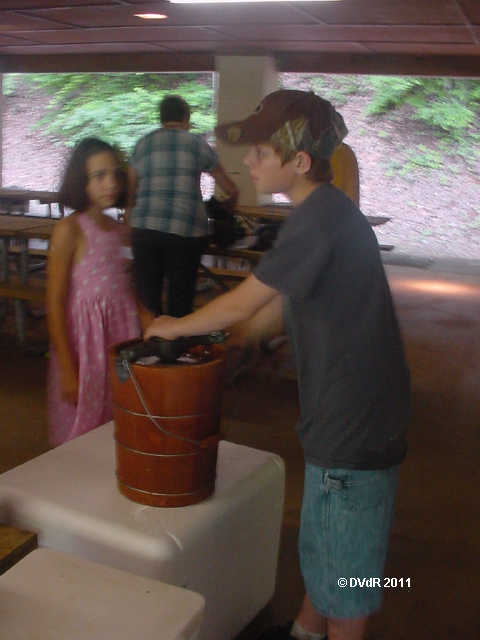
My weekend gardeners' gathering at a state park in Virginia was a LOT of fun, and the Hand Churned Ice Cream I posted about was the big hit! The grown-ups enjoyed it the most, bringing back memories and tastes of the past when foods were real.

Photo by my friend Susan in VA

The kids had fun turning the crank, but I don't think they truly appreciated the ice cream itself because they have no frame of reference for old-fashioned ice cream.


I didn't quite follow the family recipe posted in that link because later I found my mother's copy, with her notes. 

So, here's Aunt Ola's Ice Cream Recipe:


4 eggs
1½ cups sugar
2 Tbs corn starch
1 Tbs all-purpose flour
2 quarts whole milk
2 cups heavy cream
½ tsp salt
1½ tsp vanilla

Beat 4 eggs until fluffy. Mix with sugar, cornstarch and flour. Scald 1 quart of the milk; add the salt then add to the egg mixture. (The scalded quart of milk must be cooled before adding the egg mixture, or it will cook the eggs!!) Cook over low heat, stirring constantly to make the custard.

Mixture is done when it coats the sides of a spoon. Cool to room temperature.

Add the cream and the rest of the milk, and vanilla. Chill (overnight if possible), then freeze in a churn according to the manufacturer’s directions.

Ideally, you would remove the dasher after churning and put the ice cream canister in the freezer for an hour to firm up the ice cream before serving. We didn't have that luxury at the state park so we ate it on the soft side. There was a little bit of the gallon and a half left over, and I put it in the canister and packed more rock salt and ice around it in the churn until we got back to the cabin and then froze it. 

It was as good the next day... YUM!

Wednesday, June 1, 2011

Increasingly Costly Items

Of course we all know the cost of goods is increasing, and the amounts in the packaging is decreasing. (Actually, I do not believe the cost of goods is increasing, but rather the US Dollar is worth less and less all the time.) Some things are already (or soon will be) taking a bigger hit than others... here are some of my notes:

Expect the price of cane sugar to increase now that some manufacturers are (finally) switching from High Fructose Corn Syrup back to real sugar. Plus, most of our cane sugar is imported, and so far Monsanto hasn't broadcast GMO sugar cane although they are trying. They have already succeeded with sugar beets. Unless a package of sugar specifies cane sugar, it probably IS GMO beet sugar. Food products must be labeled as to contents, and sweet things may just say "sugar" although I have seen some that do specify "cane sugar". Thus far, labels saying "Non-GMO" are not allowed.

Most fruit and fruit juices are imported, either whole... or as concentrates. Expect prices to increase more than many other items due to transportation across an ocean, and cold-storage costs. Transportation costs are similar for coffee, although overall costs for coffee are worse now because world-wide weather problems have affected the coffee production yields.

Chocolate: same problems with chocolate as with coffee... weather, and transportation around the world. I'm not a big fan of chocolate but occasionally I like a bite. I buy the high percentage (84%) cocoa bars made by Lindt, since they are mostly chocolate rather than sugar, and less expensive so far than other brands. One bar can last a month or more for me, and they work well in baked goods or shaved on top of a dessert.

Stock up on whatever fruits and veggies are in season by dehydrating or canning them so there are no worries about power outages and a freezer full of food. Where you can, store winter veggies in a cool basement, in a crawl space, or in a root cellar if you are lucky enough to have one. Even the bottom of a cool, dark closet can extend the shelf life of winter produce much longer than a kitchen cabinet.
All building materials are increasing in price... particularly items like the wood used for framing because large-enough trees to mill are getting more scarce and thus more expensive to harvest (which makes paper goods made from wood pulp more expensive, too); also items like plastic plumbing parts and roofing shingles because they are petroleum-based products. 

Any household goods made from plastic, and most cleaning goods, will increase more than other items... again because of being petroleum-based. Take an hour a day away from the TV and learn to make your own laundry detergent and soap. Use vinegar for cleaning; it's antibacterial! Learn to ignore the seductive ads for products. Ask yourself how much an item will increase your quality of life, not your ego or taste buds. (That doesn't mean give up tasty foods!)

The insurance industry in the USA is taking a big hit from tornadoes and floods. Expect them to make it up by big jumps in policy costs for home and auto. Don't even think about health-care costs or health-care insurance!

Don't buy disposable batteries. Buy a solar multi-battery charger and good rechargeable batteries instead. My niece who lives here goes through 4-8 batteries a month for her iPod. In less than 1 year, she'll break even with a solar charger and rechargeable batteries. I know, I just helped her mother buy some.

Now, to offset what I said about buying frivolous items, let me encourage you to buy some fun things... one a month should not hurt the budget too much. Buy a set of Pick-Up Sticks and Tiddlywinks, a Chess-Checkers-Backgammon Set, a Scrabble Game Set (and be sure you have a real dictionary), a couple of decks of Playing Cards, and Hoyle's Book of Card Games. Maybe get a set of Jacks (remember them?) and a couple of yo-yo's and a Slinky if you have kids around. You'll be surprised how entertaining they can be when the power goes out!


Monday, May 30, 2011

It's True: they sleep, they creep, they leap


All my little Hosta's finally leaped this year, 3 years after moving them to this new spot. Of course, now they have grown so much since last year that they need dividing, but the Heucheras and Astilbes planted in there haven't bloomed yet and I don't want to disturb them.

More garden photos:

Heucheras among the hostas


Brunnera 'Jack Frost'


Bath's Pinks


Purple Siberian Iris

White Siberian Iris


Saturday, May 28, 2011

Life Expectancy of saved garden seeds

Wax Bean Seed photo by dyogi

If, like me, you are thinking of saving vegetable seeds for a future garden, here's some info about shelf life. Within these time frames, stored seed will remain viable, although germination rates may decline a little.

Typical seed life if stored in cool, dry conditions:

5 years

Broccoli
Brussels Sprouts
Cabbage
Chinese Cabbage
Celery
Chicory
Corn Salad (Mache)
Cress (both garden cress and watercress)
Kale
Kohlrabi
Lettuce
Muskmelons
Radish
Spinach

4 years
Beet
Fennel
Mustard
Pumpkin
Rutabaga
Squash (both summer and winter varieties)
Swiss chard
Tomato
Turnip
Watermelon

3 years
Asparagus
Beans
Carrot
Chervil
Cowpea
Leek
Pea
Sorrel

2 years
Corn
Dandelion
Okra
Pepper
Salsify (black)

1 year
Onion
Parsley
Parsnip
Salsify

Source: Knott’s Handbook for Vegetable Gardeners, 1980 ed.

Thursday, May 26, 2011

Mini Retort for Charcoal/Ash

I'm in the planning stages for making a variety of cheeses, and getting my list together of ingredients like starter cultures, aroma-producing bacterial and yeast additives, colorings, and even some ash used in a goat cheese like Humboldt Fog. (Who could resist a name like that?) Ash is basically activated charcoal, and easy to make at home in a semi-retort. One less thing to buy!

In the chemical industry, a retort is an airtight vessel in which substances are heated for a chemical reaction producing gaseous products to be collected in a collection vessel or for further processing. A retort is also used to make charcoal to burn in a small forge. I have a homemade retort for making charcoal, which I inoculate and use as biochar for my garden. However, it is a 30 gallon drum inside a 55 gallon drum... far too large for making ash for cheese, and I really does not capture the gases to use as fuel for the burn in process. (That type of process is described here.)

What I want for making food-grade ash is a miniature retort-style container that will drive off the gases and totally char the wood inside. Then I can grind the char into a powder via a spare coffee grinder for later use in my cheese. 

I bought a new, clean paint can, quart-size. (I may need to upgrade to a gallon size after I see how this works.)


The wood of choice for this type of ash is a fruit or nut wood or grape vines, and I had some branches available from pruning an apple tree. They do not have to be totally dry although that is best; green wood cuttings just have a higher moisture content that will still be driven off, just requiring more time and fuel for the fire itself. The retort needs to be stacked as tightly as possible to eliminate a lot of oxygen (which creates pressure inside the can when heated) from the get-go. Then the lid needs a small hole to let the heated gases escape (and prevent the can from blowing up!). I made a 3/8" hole, which may be too large, but I won't know until I try it.

Now it's prepared for the next time I build a fire, when I will put the tightly closed can on the fire/logs/coals so that I can watch the vent. When the can contents get red hot, the vent hole will start to smoke, and soon the smoke will turn to white. The water content will start to be driven off at 212ºF, and the wood will start to char at around 500ºF. After some time, maybe an hour or more depending on the temp of the fire and the moisture content inside the can, the white smoke will stop entirely, indicating all the volatile gases have been driven off.

The next step after you think the wood had charred sufficiently, is remove the can from the fire with fireplace gloves or tongs and set on a fireproof surface to cool at least 24 hours. Now it should be ready to crush and grind to a powder.


Later: I finally 'fired' the can of twigs, with only moderate success. Here just above you can see the fine smoke beginning to trail out of the hole in the can lid.


I apparently did not have either a hot-enough fire, or too small a fire... the twigs charred appropriately on the bottom, but not all the way up to the top, even though I left them on the burning briquettes and embers overnight.


Now that I'm thinking about that particular fire, I remember I used briquettes from the same bag last fall for my first cold smoking, and they produced only a very short-lasting heat. When the briquettes became covered with ash, they cooled considerably. To fully char these apple twigs, I'll apparently need build a hot wood fire to char the apple twigs.

If all else fails, I can always buy ash, but I'm NOT giving up yet!


Tuesday, May 24, 2011

Comfrey as Fertilizer, and Animal Feed

One of my several comfrey plants

I grow a lot of comfrey and it makes a great fertilizer. That's because comfrey is known as a dynamic accumulator, meaning the roots grow very deep (as much as 10 feet) and "mine" nutrients... that is, they bring nutrients up from the sub-soil and into their leaves. Those nutrients then can feed other plants if the comfrey leaves are used as a fertilizer.

Comfrey leaves have twice the nitrogen of composted manure,  about 18 times the potash, and 59 times the amount of phosphorus.

There are several ways to make fertilizer from comfrey leaves. The leaves can be put in water to dissolve, and be used as a fertilizing tea, or mixed with other liquid fertilizers. They can be put in a bucket where they will wilt and then dissolve into a very smelly liquid which can be thinned with 15 parts of water for a foliar feed or a fertilizing tea. You can also add the leaves to a compost pile.

Personally, I like to line trenches with several layers of fresh-cut leaves, cover them with a layer of dirt, and plant potatoes in the trench. I also just lay a few of layers of leaves along the sides of my tomato plants as a feeding mulch.

There are a few other plants that are also dynamic accumulators. The list includes arrowroot, borage, buckwheat, carrot leaves, chicory, clovers, daikon, kelp, lemon balm, marigold, mints, stinging nettle and yarrow. I'm sure there are others but those are the ones I know about. Most of those do not "mine" as deeply as comfrey, though.

Comfrey as Animal Feed

Comfrey is of great value as a feedstock.
 

Apparently pigs love it and will happily consume up to 20lbs a day! The Nihon Agricultural
University in Japan stated that: ‘a noticeable result was the improved health of the pigs
fed on comfrey’
not only from the allantoin, which banished scouring, but better mineral
balance.
 

Comfrey has been successfully fed to a wide range of animals from racehorses through
sheep and cattle to exotic animals such as giraffes.
 

For the homeowner and gardener who may keep poultry, comfrey can provide a
useful and productive addition to the their diet. The simple digestive system of the hen contains no bacteria or stomach enzyme able to digest cellulose so the hen receives no value from high-fiber diets. In fact this is a positive disadvantage because when the crude fiber
content reaches 10% or more, there can be a reduction in the digestibility of carbohydrates. This will cause  a fall in egg yields and delayed maturity even if the rest of the diet is nutritious.
 

Comfrey provides a low fiber, high protein and high mineral feed which can effectively replace some costly concentrates in the poultry diet. Comfrey is best served wilted and shredded, with the fibrous stalks removed to further decrease the fiber. 5 plants per laying hen should provide enough comfrey for feeding purposes.
 

Obviously comfrey is available in winter in most of the US (unless silaged) so should be replaced with other foodstuffs, such as kale or cabbage.

Sunday, May 22, 2011

Dehydrating Spinach, Strawberries


I will have an abundance of spinach growing in the garden soon, probably more than I can ever eat while it is fresh. In the meantime, I bought a pound of fresh spinach at the Farmer's Market for a recipe I didn't get around to making before the spinach would have gone bad.

Since I'd rather not depend on my freezer any more than I need to, I decided to dehydrate the spinach and store it in a jar on the pantry shelf. Spinach dries quickly and easily, although mine was still very wet from washing the grit out. It took 2-3 hours at 120ºF. (Gotta get a solar dryer built this year!) It really did not loose the bright green color, that's just a poor photo and bad lighting.


Dried spinach can be used in soups and stews all winter. Add it to tomato sauce, or scrambled eggs. You could pulverize it and add for nutritional value to almost any liquid, especially something like V-8 juice.


I put a piece in some water to rehydrate, just to see what it night be like texture-wise to use as leaf spinach in recipes later. I think it would be just fine; it was supple and not fragile at all. For sure I'll use it in a spinach lasagna!


I ended up with a quart jar packed pretty tight with dehydrated spinach. I might make more if I have an abundance of spinach in the garden. 


I have also been dehydrating strawberries, since the local berries are in season now... and cheap. Believe it or not, that pint jar above holds what was a pound and a half of fresh berries! I cut them to just a tad over a ¼" thick; the dried berries are well under ⅛" thick. Man, did they smell delightful as they were in the dehydrator!

Friday, May 20, 2011

Buying Salmon Tip


I follow Langdon Cook's blog, Fat of the Land. (His new book is Fat of the Land: Adventures of a 21st Century Forager.)

Recently he reviewed a book on sustainable seafood recipes, Good Fish: Sustainable Seafood Recipes from the Pacific Coast by Becky Selengut. In his review, he had this to say about one of the many tips from her book, and I thought I'd pass it on for anyone purchasing salmon.

"I like to think I know a few things about Pacific fish, but I'm always learning from Becky, even on familiar subjects. For instance, in her salmon chapter, she gives some buying tips that includes this useful nugget: 'Look carefully at the pin bones. If you see a divot around the pin bones, it's a sign that the fillet is old.' "

When I lived in a city, I could just ask at the fish counter to smell any fish up close so I detect if it smelled fresh. Now the markets here all wrap their fish in plastic wrap on a tray, and there's no way to smell it for freshness. The last salmon I bought smelled fishy right out of the package but I was already 35 miles away from the store, at home. Now at last I have a visual clue, thanks to Langdon Cook and Becky Selengut!

I don't buy much fish anymore except local wild stream trout, but I have her book and Langdon's both on my Wish List. Foraging ideas from Langdon Cook's book may become much more important as the cost of our food keeps going up, and Becky Selengut's book covers sustainable fish, which all fish are NOT. If I'm going to eat fish, I prefer not to eat fish that are being overfished and rapidly disappearing.

Wednesday, May 18, 2011

Marking freezer containers


I saw this tip on Michael Rhulman's blog and just HAD to pass it on...

Easy and cheap way to mark containers for the freezer, or even leftovers for the refrigerator, is with painter's tape from a hardware store, and a magic marker. I've been using freezer tape, or a slip of paper and scotch tape, but this is so much cheaper, plus the tape is wide enough to also hold the date in a small space!

Monday, May 16, 2011

A Farm for the Future

I chanced across a fantastic British documentary video series recently, A Farm for the Future. It is perhaps one of the most positive and thought-provoking things I've seen or read in some time.

I am quite impressed with how it builds to include some very promising solutions for farmers caught in the energy crunch and what that will do to our food supply. Nothing presented was actually a totally new concept to me, but the way the series takes one woman beef farmer through the realizations of oil shortages and increasing costs all the way up to some workable solutions is quite well done.

I came away with a much better understanding of some basic, workable concepts like a forest garden. I have read the concept of forest farming here and there, but it was all text and line drawings, and I hadn't any real understanding. Seeing two examples on film in real life with some explanations to how and why it works totally changed my viewpoint, and I plan to begin some implementation here at home as money and time permits, in the form of guilds. It is the only thing that now makes sense to me in becoming sustainable in an uncertain future. Martin Crawford, who explains and demonstrates forest gardening (including animal feed from one) on the last 2 videos, has a book explaining how to do it yourself. The book is Creating a Forest Garden: Working with Nature to Grow Edible Crops. Another good book is Gaia's Garden.

I encourage everyone concerned about the future of our food supply (and that's everything from our own home gardens to giant corporations that are farming thousands of acres) to watch all 5 videos; they each are fairly short. Here's the link to the first one, and it will lead you to the others in order.


Sunday, May 15, 2011

Blog Birthday / Anniversary!

Photo by Leon Wilson

Today marks two years of posting on this blog. In that time, it has grown from a very few followers who are mostly old friends who just supported my initial efforts, to now over sixty followers... and that number does not include the readers who follow with an RSS feed. (I have no way of knowing how many follow in that manner.)

Page views have grown from a handful a week, to nearly 200 per day... that number also does not include RSS feed page views. Viewers come from all over the world

I must say that I am extremely pleased, esp. considering that as of late 2009 there were over 126 million blogs, and growing!

Folks have asked if I get any remuneration from my blog. I do not. I consider writing my blog as "paying it forward" for all the help, instruction and ideas that people have sent my way throughout my lifetime. 

Photo by MShades

If anyone gets just a little help, a little more understanding of something, some encouragement or even some inspiration from my blog, it's just icing on the cake!

Saturday, May 14, 2011

Making Neufchâtel Cheese


Actually it is American Neufchâtel, which is a low-fat cream cheese. I plan to make cheesecake with my American Neufchatel, but it also makes a good base for adding herbs or garlic to use as a spread. (Real Neufchâtel is a soft, slightly crumbly, mould-ripened cheese made in the region of Normandy in France. It looks similar to camembert, with a dry, white, edible rind, but the taste is saltier and sharper.) 

The recipe is very simple:
2 gallons of skim milk
1 cup cultured buttermilk or yogurt or raw milk clabber (I used non-fat buttermilk)
1/4 tsp. liquid rennet (or half a rennet tablet dissolved in 1/4 cup cool distilled water)

Whisk buttermilk until thin, and whisk in the rennet. Then whisk the mixture into the milk. Allow to set at about 72ºF for 10-12 hours. I started mine in the evening so it could mature overnight... otherwise I'd be doing the draining well into the night!

Curds after overnight maturation. Notice the yellow whey gathering on top.

Soft Curds (partial amount) Draining

The next morning, ladle the curds into a butter-muslin (or fine cheesecloth) lined colander and allow to drain. You might have to scrape the inside of the muslin as the curds will form a film that slows or even stops the draining.


When it has drained the consistency you want, put the curds in a big bowl and add salt one teaspoon at a time, tasting until you get the flavor you like. I added just 2 teaspoons of salt, which is barely salty enough for my taste. (I will adjust if necessary when I make the cheesecake.) Salt keeps the cheese from tasting too bland, and helps it keep longer. 

Wrap in waxed paper or recycled plastic food containers and refrigerate. My 2 gallon batch weighed 53.3 oz., or 6½ packages of store-bought cream cheese only better, and without additives to thicken it.

Friday, May 13, 2011

Ag Gag Bills

I've been watching the proliferation of recently Ag-Gag Bills, and frankly I am fed up with BigAg trying to run my life, and to hide from whistle-blowers. Right now BigAg is pushing legislators in Florida, Minnesota and Iowa to criminalize taking photos or videos of their facilities. (Update: the Florida Bill SB 1246 failed.)

I'm pretty sure not all CAFO's are ugly and inhumane ... but some are. Now "they" want to make it a crime to take photos of a facility that indulges in practices that would turn our stomachs, much less the thought of buying their meat.

What are they fearing? The way factory farming mistreats animals, workers AND the environment? 

Environmental Protection Agency head Lisa Jackson assured a gathering of agricultural leaders in Iowa that her agency has no plans to regulate farm runoff, despite its hazards. 

On the other hand, the Des Moines Register reported, “Runoff of nitrogen and phosphorus from farms damages water quality in Iowa and elsewhere in the Mississippi basin and contributes to a dead zone in the Gulf of Mexico.”

The Bill approved in the Iowa House and Senate sponsored by Rep. Annette Sweeney, a Republican and a former executive director of the Iowa Angus Association, would not only punish whistleblowers but also those who take jobs for the sole purpose of exposing abuses. Those convicted could face penalties include fines of up to $7,500 and five years in prison. 

People for the Ethical Treatment of Animals, or PETA, say: “They’re trying to criminalize someone being an eyewitness to a crime,” Jeff Kerr, the organization’s general counsel, said. The measure was introduced after humane groups released videos showing chicks being ground alive and pigs being beaten and shocked.

Kansas and Montana have passed anti-whistleblower laws, and though they aren’t aimed at secret filming in factory farms, Tom Laskawy from Grist says the effort is coordinated. “Big Ag has been known to coordinate legislative campaigns state by state,” he said, pointing to Monsanto’s ultimately unsuccessful push to prohibit labels on milk that alert customers to the presence of artificial hormones.

A bill introduced in the Minnesota House in early April punishes not only videographers who pose as workers and record the inhumane treatment of animals, but also those who distribute said videos. The bill seeks to make it a felony to disrupt operations at factory farms, a component intended to punish activists and protesters. One of the sponsors is Rep. Rod Hamilton, a former president of the Minnesota Pork Producers.

I DO have a problem with the Animal Agriculture Alliance inferring that "Radical Vegans" are behind some of the photos. However, they do say these people shouldn’t have to sneak the cameras into the farms that are torturing animals or mistreating workers: the cameras should already be there. It should be the state’s responsibility to find and monitor the few farmers that are giving the rest of them a bad name. You want to quiet the crazy vegans with the video cameras? Do their job for them.

Here are some links for more information:

http://www.slowfoodusa.org/index.php/slow_food/blog_post/goats_pigs_cows_farm_dogs_ready_for_their_close-ups/

Blogger Editing and Posting was AWOL

Sorry for the delay in the 2 posts below. They were scheduled for just after midnight EST on the 11 and 12, but Blogger was screwed up for any editing and new posting since mid-day Thursday.

Thursday, May 12, 2011

Hand Churned Ice Cream


Real ice cream. When is the last time you had any real ice cream, made with just the natural ingredients of milk, heavy cream, egg yolks, sugar and a flavoring like vanilla? NO guar gum, no food grade carrageenan, no locust bean gum, no skim milk, no artificial flavors...


I was gifted a new wooden ice cream churn (hand cranked) last fall and I will take it in a few days to a gardening get-together at a state park. I'll make my family ice cream custard recipe the night before and pick up ice along the way; there will be a few kids at our party to help crank the churn.

Vanilla Ice Cream
4 egg yolks
1½ cup sugar, or more to taste
2 quarts whole milk
2 cups heavy cream (luckily I can get non-Ultra-pasteurized)
½ tsp salt
1½ tsp vanilla, or to taste

Beat 4 egg yolks until fluffy. Add sugar and mix until pale yellow. Scald 1 quart of the milk; add the salt, then cool enough so it doesn't cook the eggs; slowly add the egg mixture, whisking it in slowly. Cook over low heat, stirring constantly to make the custard. Do not let it boil!

Mixture is done when it coats the sides of a spoon. Cool.

Add the cream, the rest of the milk, and vanilla. Chill, then freeze in a churn according to the manufacturer’s directions.


YUM!

Tuesday, May 10, 2011

Feta, Take 3


I am determined to make good feta! Actually the 2 batches I have made previously have tasted just fine, but melted into the brine after just a day or three in the refrigerator. That is NOT how feta should store!

I didn't do anything different with the 'make' of this third feta, it is the same recipe as here. What I did do differently (based on input from other cheesemakers who initially had the same problem) was twofold. For one, I let the curds drain for 24 hours in the bag, as opposed to 3-4 hours in most recipes.
Secondly, after the cheese was cut into slabs from the hunk above, I salted it and left it at room temps for 3 days to harden. (See photo at top.)

Half-gallon jar with feta slabs, ready for chilled brine

Then I made a batch of light brine with whey as the liquid, and covered the cheese. I added 3 mL calcium chloride to the half-gallon of brine, in addition to 400 grams of salt.


So far, so good! The brine is not clear because I used whey and not water, but if my 'advisors' are correct, this feta should keep for months if I don't eat it all first (which is likely with warm weather produce coming on; I love feta on salads).

Update: I made the feta on April 22, and put in the brine April 26. So far it is holding well!!

Sunday, May 8, 2011

Food Packaging Deceptions


This REALLY annoys me! I bought a 4-pack of grahams at Sam's to have on hand for a couple of cheesecakes I want to make with homemade real cream cheese. As you can see in the photo above, the contents are well below the top of the box, whereas they used to fill the box completely.

I know these are "sold by weight" but WHO remembers how much a box of grahams used to weigh???


Not only are the contents lower in the box, they are also several crackers shy of filling the width of the box. I'd much rather knowingly pay more (I actually did pay more anyway, considering the contents!) than to have this deception practiced on me.